


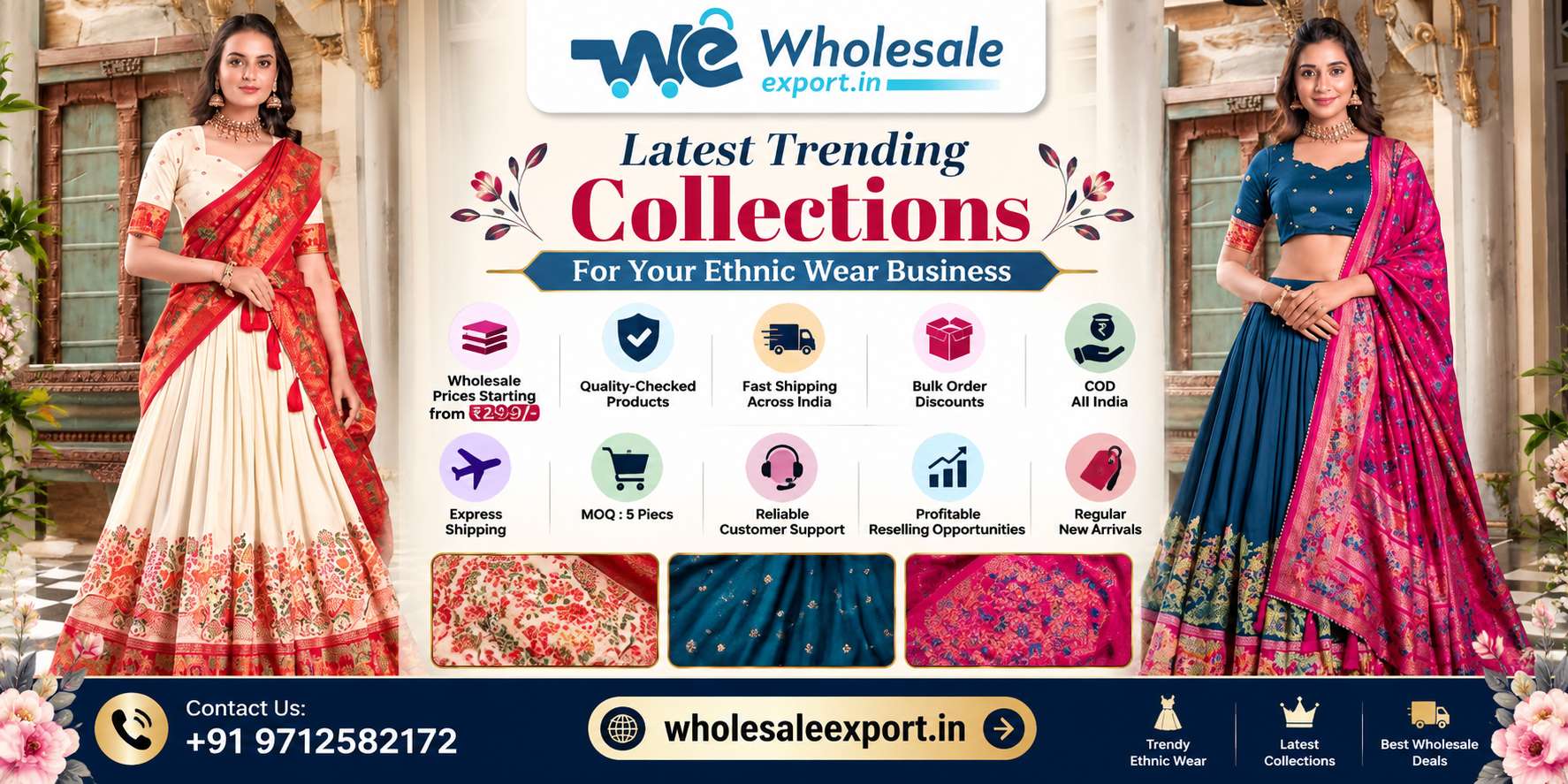
Why Regular New Arrivals Matter for Clothing Retailers in 2026
Why Regular New Arrivals Matter for Clothing Retailers in 2026
Fashion customers rarely want to see exactly the same collection every time they visit a store, browse a website or open a seller's WhatsApp catalogue. Fresh designs create another reason to return, while a well-planned flow of new products gives retailers more opportunities to sell to existing customers without depending entirely on finding new buyers. For ethnic wear businesses, this freshness becomes especially valuable around changing seasons, festivals, weddings and fast-moving fashion trends.
Introduction
Regular new arrivals for clothing retailers are not simply about making a shop look busy. When managed correctly, fresh inventory can support repeat customer visits, improve product discovery, create marketing content and help retailers respond to changes in demand.
This matters across different business models. Home-Based Sellers need something fresh to share through WhatsApp and Instagram. Boutique Owners need new designs to maintain a curated identity. Shop Owners and Showroom Owners need changing displays to encourage repeat footfall. Resellers and Wholesale Buyers need access to products that their own customers have not already seen repeatedly.
In 2026, the challenge is not necessarily finding more products. Retailers can access thousands of designs online and through major wholesale markets. The real challenge is selecting the right products, introducing them at the right frequency and maintaining enough working capital to continue refreshing inventory.
Surat plays an important role in this supply cycle. The surat textile market, Ring Road, Sahara Darwaza and surrounding textile ecosystem connect buyers with wholesale, processing and manufacturing businesses across multiple women's ethnic wear categories. Online sourcing through Wholesaleexport.in can also help retailers explore new collections without depending entirely on repeated physical sourcing visits.
New Arrivals Give Existing Customers a Reason to Return
Customer acquisition can require advertising, content creation and promotional effort. Once someone has already purchased from a business, fresh products create a natural reason to communicate with that customer again.
A boutique that changes only a small part of its collection over several months may struggle to create urgency among repeat visitors. If customers assume they have already seen most of the available stock, they have less reason to browse frequently.
Freshness Creates Repeat Product Discovery
When new sarees, kurti sets, lehenga choli, salwar suits, dress materials or other ethnic wear arrive regularly, each update becomes another discovery opportunity.
This does not mean retailers need to replace their entire inventory every week. Even controlled additions can keep the collection active when products are selected according to genuine customer demand.
Repeat Customers Can Become More Valuable Over Time
A customer who purchases repeatedly can contribute significantly more to a retailer than someone who makes one transaction and never returns. New arrivals give retailers a legitimate reason to maintain that relationship.
Instead of sending generic promotional messages constantly, businesses can communicate useful updates such as a new festive collection, fresh cotton designs, newly received premium suits or restocked bestselling styles.
Regular New Arrivals Help Retailers Follow Changing Fashion Demand
Fashion demand does not remain static. Colours, embroidery, prints, silhouettes, fabrics and styling can change according to season, festivals, celebrity-inspired looks, social-media exposure and regional preferences.
A retailer who buys a very large quantity of one trend and keeps selling it for too long can eventually appear outdated. A more flexible buying model allows selected new styles to enter the inventory while proven products continue selling.
Trends Can Be Tested Without Overbuying
When a new fashion trend appears, retailers do not necessarily need to purchase deep quantities immediately. A controlled initial order can be introduced to customers first.
Track actual orders, not just social-media views. If the product converts into sales, the retailer can consider similar designs or additional quantities while the trend remains active.
Core Products and Trending Products Should Work Together
A successful store does not need to become completely trend-driven. Proven categories can provide stability while trend-led products add freshness.
For example, a retailer might maintain dependable everyday kurtis or sarees while introducing selected designer suits, festive lehengas or new embroidery styles. This balance can reduce inventory risk while keeping the store visually current.
New Collections Create Continuous Content for Online Sellers
For online clothing businesses, inventory and marketing are closely connected. Every fresh collection can produce multiple pieces of content.
A new product can become an Instagram Reel, Story, WhatsApp Status, catalogue update, website listing, customer broadcast and short product video. This makes new ethnic wear collections useful not only for inventory but also for customer engagement.
Home-Based Sellers Need Fresh Content to Stay Visible
Home-Based Sellers often operate without a physical showroom. Their digital presence effectively becomes their shop window.
If the same catalogue is circulated repeatedly, customers may stop opening the updates. Regular but controlled new arrivals can help the seller maintain interest without depending entirely on discounts.
Boutiques Can Turn Each Arrival Into a Mini Launch
Boutique Owners can present new inventory in smaller themed launches. One week might focus on festive suits, another on sarees and another on premium lehengas.
This approach gives individual collections more visibility and prevents customers from being overwhelmed by hundreds of products at once.
Fresh Inventory Can Improve Store Presentation
Physical retailers also benefit from product rotation. A customer may walk past the same shop regularly, and a refreshed window display can create a new reason to enter.
Changing mannequins, front displays and featured collections can make the business feel active even when some core inventory remains unchanged.
Use New Arrivals in High-Visibility Areas
Fresh products can be positioned near the entrance, front display or other prominent locations. Existing inventory can then be organized by category, occasion or price range deeper inside the store.
This gives repeat visitors an immediate visual signal that something has changed since their previous visit.
Combine New Products With Proven Bestsellers
Do not hide successful existing products simply because something new has arrived. A strong merchandising strategy can present fresh products alongside established sellers.
This combination gives customers both novelty and familiarity, while the retailer avoids replacing stock unnecessarily.
Regular New Arrivals Can Support Better Inventory Rotation
New stock is valuable only when inventory remains under control. Buying continuously without monitoring older products can create the opposite result: too much stock and insufficient working capital.
The goal of regular new arrivals for clothing retailers should therefore be controlled rotation, not uncontrolled accumulation.
Track Sell-Through Before Reordering
Retailers should know which designs sell quickly, which require more time and which repeatedly remain unsold. This information can guide the next wholesale purchase.
If a particular fabric, colour or price segment performs consistently, similar products may deserve a larger share of future purchasing. Slow categories can receive less investment until customer demand changes.
Protect Working Capital for the Next Collection
One common mistake is investing too much money in a single buying cycle. Even attractive products can become a problem if the business has no available cash when the next strong collection appears.
Retailers can keep part of their purchasing budget available for replenishment and new trends. This provides greater flexibility and reduces dependence on one inventory decision.
New Arrivals Can Help Retailers Sell Across Different Price Segments
A fresh collection does not always need to mean a higher price. Retailers can introduce new products across affordable, mid-range and premium segments.
Affordable New Arrivals Can Drive Volume
Value-focused products can attract customers looking for regular purchases or budget-friendly fashion. For Resellers, these products may also provide opportunities to reach a wider audience.
The retailer should still evaluate fabric and finishing carefully. A low wholesale price is useful only when the product provides suitable value for the intended customer.
Premium New Arrivals Can Increase Average Order Value
Premium collections can serve customers shopping for weddings, festivals, parties and special occasions. Detailed embroidery, richer fabrics and distinctive styling can justify different price positioning when product quality supports it.
For Boutique Owners, selected premium pieces can also strengthen the overall visual identity of the store even when much of the business comes from mid-range products.

Surat Wholesale Sourcing Makes Frequent Collection Updates Possible
Surat's large textile ecosystem gives retailers access to continuously changing women's fashion collections. Buyers sourcing through the surat textile market, Ring Road, Sahara Darwaza and surrounding wholesale areas can explore multiple categories and price levels.
This variety can support a regular-new-arrival model because retailers do not have to depend entirely on one product type. They can introduce products according to customer response, season and available buying capital.
Ring Road and the Wider Wholesale Network
Ring Road is strongly associated with Surat's textile trade and provides access to businesses serving retailers, Resellers and Wholesale Buyers across India and other markets.
The volume of choice makes disciplined purchasing important. Retailers should enter the sourcing process with clear requirements rather than purchasing every attractive catalogue they see.
Sahara Darwaza and Textile Market Access
Sahara Darwaza and surrounding textile areas form another part of Surat's broader trading ecosystem. Buyers can use this market access to compare collections according to fabric, styling, quantity and target selling price.
Businesses that cannot travel to Surat regularly can also use Wholesaleexport.in to explore wholesale collections online and maintain a more convenient sourcing cycle.
Why New Arrivals Matter Before Festivals and Wedding Seasons
Freshness becomes especially important when customers are actively shopping for festivals and weddings. During these periods, customers may compare several stores and online sellers before choosing an outfit.
Retailers who introduce their seasonal collections early have more time to promote products, observe demand and potentially reorder successful styles.
Launch Before Peak Demand
Waiting until immediately before a festival can reduce the selling window. Products need time for receiving, checking, photography, display and customer promotion.
An early launch can also reveal which products deserve additional investment before the season reaches its strongest stage.
Keep Selected Freshness Throughout the Season
Instead of launching the entire festival inventory on one day, retailers can hold back selected collections for later releases. This helps maintain customer interest throughout the selling period.
However, products should not be deliberately delayed so long that they miss their strongest selling opportunity. The release schedule should follow customer demand rather than a rigid content calendar.
Vastralife Wholesale and Export Experience Since 2017
For retailers who depend on regular collections, sourcing experience matters. Vastralife brings wholesale and export experience since 2017, supported by industry expertise in women's ethnic wear and B2B requirements.
Different businesses need different buying patterns. Home-Based Sellers may require manageable quantities and frequent updates, while Showroom Owners and Wholesale Buyers can require greater product depth and larger order volumes.
Across these models, premium product quality, fresh collections and practical wholesale sourcing can support repeat business. Wholesaleexport.in provides an online route for buyers exploring changing women's ethnic wear collections for their own retail or resale requirements.
New Arrivals for Export and International Resellers
The need for fresh collections is not limited to Indian retailers. Buyers serving Nepal, Canada and Australia can also use regular product updates to keep their ethnic wear assortment current.
For export buyers, however, timing needs additional attention. International transportation means the product may need to be selected and dispatched considerably earlier than the date customers are expected to purchase it.
Plan International New Arrivals Around the Destination Market
A collection should be considered new when it reaches the customer, not merely when it leaves the supplier. International retailers should therefore work backwards from their local selling calendar.
This is especially important for festival and wedding inventory, where arriving late can significantly shorten the useful selling period.
Calculate Landed Cost Before Setting Retail Prices
Export buyers should consider product cost, freight and other applicable destination-related expenses before deciding the final selling price. A collection that appears inexpensive at the wholesale level may have a different cost structure after transportation.
The next stage is to turn regular new arrivals for clothing retailers into a structured buying system. Part 2 continues with buying frequency, customer segmentation, stock rotation, the second product image, exactly two relevant internal keyword links, Customer FAQs and a complete wholesale sourcing CTA.
How Often Should Clothing Retailers Add New Arrivals?
There is no single new-arrival schedule that works for every clothing business. The ideal frequency depends on customer demand, sales volume, working capital, product category and how quickly existing inventory moves.
A high-volume Showroom Owner may require frequent product additions, while a Home-Based Seller can operate successfully with smaller, carefully selected updates. The objective is to establish a rhythm customers recognize without forcing unnecessary purchases simply to maintain a schedule.
Use Sales Velocity to Decide Buying Frequency
Retailers should monitor how quickly recently purchased products sell. If new collections consistently move within a short period, more frequent buying may be justified. If inventory remains for months, adding stock faster could create a cash-flow problem.
Track confirmed sales by category and compare them with the quantity purchased. This creates a more reliable purchasing signal than social-media engagement alone.
Small and Frequent Can Be Better Than Large and Infrequent
Depending on supplier terms and logistics, smaller recurring purchases can sometimes give retailers more flexibility than investing the entire buying budget in one large order.
This approach allows a business to respond to customer feedback, seasonal demand and emerging trends while preserving capital for the next buying opportunity.
Segment New Arrivals According to Your Customers
Not every customer needs to receive every product update. Customer segmentation can make new-arrival marketing more relevant and reduce unnecessary promotional messages.
Create Categories by Buying Preference
Retailers can organize customers according to interests such as sarees, lehenga choli, kurtis, Pakistani suits, dress materials, festive wear or premium ethnic wear.
When a relevant collection arrives, those customers can be contacted first. A buyer who regularly purchases sarees is more likely to appreciate a saree update than an unrelated catalogue.
Segment Customers by Price Range
Purchase history can also indicate preferred spending levels. Some customers regularly choose affordable daily wear, while others prefer premium occasion wear.
Showing suitable products can make communication more useful. It also helps retailers avoid assuming that every customer wants either the cheapest or most expensive option.
Use New Arrivals to Increase Repeat Orders
Regular new arrivals for clothing retailers provide a natural opportunity to reconnect with customers who have already purchased. Instead of relying on constant discount campaigns, retailers can lead with genuine product freshness.
A simple message announcing newly received products can be more relevant than repeatedly sending the same catalogue with different promotional wording.
Contact Previous Buyers With Relevant Collections
If a customer previously purchased a particular type of kurti or saree, a new collection in a similar category can create a useful follow-up opportunity.
The objective should be relevance rather than message volume. Frequent irrelevant broadcasts can reduce engagement, while targeted updates can strengthen the customer's relationship with the business.
Use Restocks Differently From New Arrivals
A restocked bestseller and a completely new design are two different marketing opportunities. Tell customers clearly when a popular product is available again, particularly if they previously enquired about it.
New arrivals, meanwhile, can be presented around freshness, new styling, colours or seasonal relevance.

Build a Balanced New-Arrival Buying Formula
A practical buying strategy combines proven products with controlled experimentation. Retailers need enough familiarity to maintain dependable sales and enough freshness to prevent the collection from becoming repetitive.
The exact balance will vary by business, but every buying decision should answer three questions: Who is likely to buy this product? At what price can it realistically sell? How much quantity can the business comfortably hold if sales are slower than expected?
Keep Proven Sellers in the Buying Mix
Previous sales data can identify fabrics, categories, colours and price segments that repeatedly perform. These products can form the stable part of the inventory.
The retailer can then introduce fresh designs within those proven categories rather than completely changing direction with every wholesale purchase.
Reserve Part of the Budget for New Trends
Maintaining available working capital gives retailers the flexibility to react when an attractive trend or strong seasonal collection enters the market.
This is particularly useful in 2026, when fashion visibility can increase quickly through Instagram Reels, short videos and other digital channels. Retailers who have already committed their entire buying budget may struggle to respond when genuine customer demand appears.
Internal Linking Section for New Collection Buyers
Retailers preparing festive, wedding and occasion-wear assortments can explore the wholesale lehenga market in Surat to review changing designs and price segments for boutiques, shops, Resellers and Showroom Owners.
Businesses looking to broaden their regular ethnic wear assortment can also explore the Ahmedabad kurti wholesale market category and evaluate products according to their customer profile and current inventory requirements.
New categories should ideally be introduced in controlled quantities first. Once customer response is established, buyers can increase their investment in the segments producing consistent orders.
Avoid Turning New Arrivals Into Excess Inventory
Fresh stock can increase customer interest, but continuously purchasing without stock control can damage profitability. The purpose of new arrivals is to improve inventory movement, not simply increase the number of products stored in the business.
Review Old Stock Before Every New Purchase
Before placing another wholesale order, review what remains from previous buying cycles. Identify fast-moving, moderate and slow-moving inventory.
If one category already has substantial unsold stock, adding more similar products may not be necessary unless there is a clear change in customer demand.
Do Not Confuse Variety With Excess Quantity
Customers may appreciate variety, but a retailer can offer variety through selected designs rather than deep quantities of every style.
This is particularly useful for Boutique Owners and online Resellers who want to maintain visual freshness without tying excessive capital to individual designs.
Rotate Slow Stock While It Is Still Relevant
Products that begin moving slowly can be repositioned through fresh styling, new photographs, videos or different merchandising. If commercially appropriate, genuine combination or clearance offers can also be considered.
Acting early gives the retailer more options than waiting until the product has become significantly outdated.
Use New Arrivals to Improve Average Order Value
Fresh collections can also encourage customers to purchase more than one product when recommendations remain relevant. A customer shopping for a festive outfit may also be interested in another design for a separate function.
Present Complementary Choices Instead of Random Upselling
Rather than showing every available product, retailers can present a small number of suitable alternatives across different price levels.
This improves the buying experience and can increase transaction value without making the customer feel pressured.
Use New Arrivals for Multi-Piece Wholesale Orders
Resellers and Wholesale Buyers may prefer a broader assortment when purchasing for their own customers. Fresh catalogues can help them build mixed inventory rather than depending on older repeated designs.
Bulk purchasing should still follow expected sales. Higher quantity makes sense when demand, margins and available working capital support it.
Regular New Arrivals for Boutique Owners
Boutique Owners can use new arrivals differently from mass-volume sellers. Instead of competing only on quantity, boutiques can create curated selections with a recognizable style.
A smaller number of distinctive pieces can sometimes create a stronger impression than hundreds of similar products. Presentation, styling and product selection become part of the boutique's value proposition.
Create Themed Collection Drops
New arrivals can be organized around themes such as festive edit, wedding collection, summer cotton, premium suits or celebration lehengas.
Themed launches make digital promotion easier and help customers understand why the new collection is relevant to them.
Keep the Boutique Identity Consistent
Following trends does not mean purchasing every popular product. Select trends that fit the customers and identity the boutique has already developed.
This makes new collections feel fresh without making the store appear completely different with every buying cycle.
Regular New Arrivals for Home-Based Sellers and Resellers
Home-Based Sellers often operate with lower fixed infrastructure costs, but working capital can still be limited. This makes disciplined purchasing particularly important.
Instead of buying a very large collection immediately, sellers can introduce smaller product drops and increase purchasing according to confirmed customer demand.
Turn Every New Catalogue Into Multiple Selling Opportunities
A single collection can be promoted through WhatsApp Status, Instagram posts, Reels, customer groups and direct follow-ups. This allows the seller to extract more marketing value from each wholesale purchase.
Clear photographs, fabric information, available options, price and ordering instructions can make the content more useful for serious buyers.
Track Which Products Generate Paid Orders
Likes, views and enquiries can indicate interest, but confirmed orders should guide future buying. Maintain simple records showing which collections actually convert into sales.
Over time, this information can help the seller create a more profitable purchasing pattern.
Regular New Arrivals for Showroom and Shop Owners
Larger physical retailers may require more inventory depth, but the same principles apply. New products should be introduced according to sales and customer demand rather than simply filling available display space.
Refresh High-Visibility Displays Regularly
Use newly received products in windows, entrance displays and featured sections. This can help repeat customers immediately notice that the store has changed.
Older proven products can remain available in their regular sections while new collections receive temporary prominence.
Connect Physical Stock With Digital Marketing
Every important store arrival can also be promoted online. Customers who cannot visit immediately can discover products through Instagram or WhatsApp and contact the business before travelling.
This creates a stronger connection between offline inventory and digital customer acquisition.
New Arrivals and Export Opportunities in 2026
Businesses serving Nepal, Canada and Australia can also build a new-arrival strategy for their local ethnic wear customers. However, export purchasing requires longer planning because the merchandise must travel before it can enter the destination market.
Plan According to the Customer's Calendar
International buyers should identify when customers in their destination market will begin shopping and work backwards from that date.
This is especially important for festival collections. A product dispatched from India while demand is already peaking overseas may arrive too late to achieve its full selling potential.
Include Logistics in the Final Price
Product cost is only one part of an international order. Freight and other applicable destination-related expenses should be included when calculating landed cost and resale pricing.
Buyers should therefore compare products based on their complete business economics rather than the Indian wholesale price alone.
How Surat Supports a Continuous New-Arrival Cycle
The surat textile market ecosystem gives retailers access to changing products across women's ethnic wear. Ring Road, Sahara Darwaza and surrounding commercial areas are connected with wholesale, trading and manufacturing activity serving buyers from India and overseas.
This product depth can help retailers refresh their assortments according to season, price range and customer demand.
Wholesaleexport.in provides an online sourcing route for businesses that want access to changing wholesale collections without travelling to Surat for every buying cycle.
Vastralife Wholesale and Export Experience Since 2017
Vastralife brings wholesale and export experience since 2017, along with industry expertise in women's ethnic wear and B2B sourcing requirements.
For retailers, access to fresh collections becomes more useful when it is combined with practical wholesale sourcing and premium product quality. A successful long-term buying strategy should help the retailer maintain variety without losing control of inventory.
Whether the buyer operates a home-based business, boutique, retail shop, showroom or wholesale network, the objective remains similar: purchase products that match real customer demand and introduce new stock at a pace the business can sustain.
Customer FAQs
1. Why are regular new arrivals important for clothing retailers?
New arrivals can give existing customers a reason to return, provide fresh marketing content and help retailers respond to changing fashion demand. Their value depends on buying at a pace that matches actual sales.
2. How often should a clothing retailer add new products?
There is no universal schedule. Buying frequency should depend on sales velocity, customer demand, available working capital, supplier terms and the amount of existing inventory.
3. Should I buy a large quantity of every new design?
Not necessarily. New or trend-driven products can initially be purchased in controlled quantities where supplier terms allow. Confirmed customer response can then guide additional buying.
4. How can new arrivals increase repeat customers?
Fresh products give retailers a genuine reason to reconnect with previous buyers. Relevant updates based on a customer's interests can be more useful than repeatedly promoting the same inventory.
5. Which products can be included in ethnic wear new arrivals?
Depending on the business, new arrivals can include sarees, lehenga choli, kurtis, kurti sets, dress materials, salwar suits, Pakistani suits, Anarkali suits and other women's ethnic wear.
6. Are new arrivals useful for Instagram and WhatsApp sellers?
Yes. Fresh products can generate Reels, Stories, WhatsApp Status updates, catalogues and direct customer messages, giving online sellers regular product-focused content.
7. How can retailers avoid dead stock while adding new arrivals?
Review existing inventory before purchasing, track sell-through, test trends with controlled quantities and keep part of the buying budget available instead of investing everything in one cycle.
8. Is Surat suitable for sourcing regular ethnic wear collections?
Surat has a large textile trading and manufacturing ecosystem across Ring Road, Sahara Darwaza and other market areas, giving wholesale buyers access to multiple categories and price segments.
9. Can international Resellers purchase new arrivals from India?
Yes, subject to supplier terms and destination requirements. International buyers should account for transportation time and landed cost, particularly for seasonal collections.
10. Should retailers replace bestselling products whenever new stock arrives?
No. Proven products can remain part of the assortment while new designs are introduced around them. The objective is to combine reliable sellers with enough freshness to maintain customer interest.
Keep Your Collection Fresh With Wholesaleexport.in
Regular new arrivals for clothing retailers can become a powerful growth tool when freshness is combined with disciplined purchasing. The goal is not to keep buying more stock; it is to continuously introduce the right products while rotating inventory and protecting working capital.
Explore Latest Collections, competitive Wholesale Pricing and Trendy Ethnic Wear for Home-Based Sellers, Shop Owners, Boutique Owners, Showroom Owners, Resellers and Wholesale Buyers.
Wholesaleexport.in offers wholesale sourcing options with Fast Shipping, COD Support where applicable, Bulk Order Deals according to current terms and Quality Products Starting From ₹299.
Contact Number: +91 9712582172
Website: wholesaleexport.in
For 2026, retailers who combine fresh collections with sales data, controlled inventory and consistent customer communication can build a healthier buying cycle. Introduce new products regularly, measure what customers actually purchase and use those results to decide what deserves the next investment.