


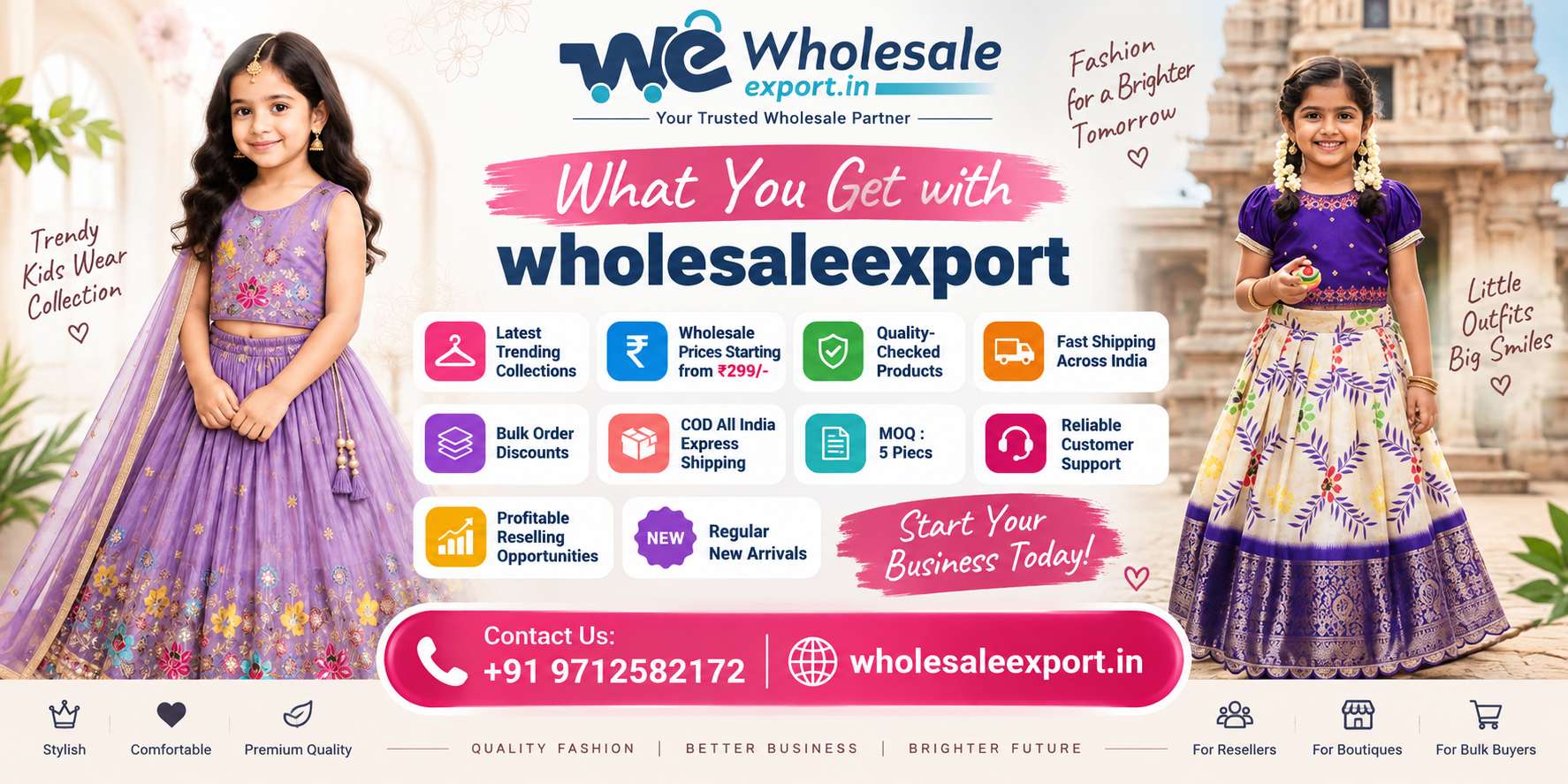
Wholesale Ladies Clothing with Minimum 5 Pieces Order – Surat Wholesale Supplier 2026
Wholesale Ladies Clothing with Minimum 5 Pieces Order – Surat Wholesale Supplier 2026
Starting or expanding a clothing business no longer means investing heavily in large quantities of one design. Retailers, boutique owners, online resellers and home-based sellers increasingly prefer smaller wholesale orders that allow them to test fresh styles while keeping their inventory flexible. Wholesaleexport.in connects buyers with a broad selection of women’s ethnic and fashion collections sourced from Surat, making it easier to purchase market-ready products in manageable quantities and regularly refresh the styles offered to customers.
Introduction
The Indian women’s clothing market moves quickly. A design that performs strongly today can be replaced by another trend within weeks, especially when customers discover new looks through Instagram, Facebook, YouTube and online marketplaces. For a small retailer, carrying excessive quantities of a single design can therefore tie up valuable working capital.
This is where wholesale ladies clothing with minimum 5 pieces order becomes useful. Instead of committing a large amount of money to one style, eligible collections with a five-piece minimum allow buyers to build a more varied inventory. A seller can select products according to season, customer profile, selling price and local demand while keeping the initial purchase more manageable.
Wholesaleexport.in is designed for buyers searching for wholesale women’s clothing from Surat. The platform serves home-based sellers, shop owners, boutique owners, showroom owners, resellers and wholesale buyers looking for products suitable for their individual markets.
Surat remains an important sourcing centre for Indian ethnic wear, with textile activity spread across the Surat textile market, Ring Road, Sahara Darwaza and surrounding commercial areas. Access to a broad textile ecosystem makes the city a practical sourcing destination for buyers looking for regular collections, competitive wholesale price points and a wide variety of Indian clothing.
Why Minimum 5 Pieces Wholesale Ordering Matters in 2026
Traditional wholesale buying often involves complete catalogues or comparatively high quantities. That model can work well for established retailers with predictable sales, but it may be difficult for a new reseller or a boutique that wants more variety with controlled inventory.
A minimum 5 pieces wholesale order can reduce that entry barrier on applicable products. Buyers get an opportunity to start with a smaller assortment, understand customer response and reorder or move into other collections according to actual sales.
Lower Initial Inventory Commitment
Inventory is one of the largest working-capital requirements for a clothing business. Buying smaller wholesale quantities means a seller can distribute the purchasing budget across multiple designs instead of putting a large portion of it into one catalogue. This is particularly useful for home-based sellers and new online resellers who are still identifying which colours, fabrics, sizes and price ranges work best for their customers.
More Variety for Boutique and Retail Customers
Customers often judge a fashion seller by variety. A shop displaying different kurtis, suits, sarees, dress materials and festive products may offer customers more reasons to browse. Smaller wholesale quantities can help retailers rotate stock and introduce latest ladies clothing collections more frequently.
Better Product Testing for Online Resellers
Online sellers can test product photographs, reels, WhatsApp catalogues and marketplace listings before making larger repeat purchases. Instead of predicting demand, sellers can use actual enquiries and conversions to identify the products their audience prefers.
For businesses operating in 2026, this flexible purchasing approach is especially relevant because digital fashion trends can change rapidly. A five-piece starting quantity on applicable collections can support quicker product testing without requiring the buyer to maintain unnecessarily deep stock.
Wholesale Ladies Clothing Categories Buyers Can Source
A strong women’s clothing business usually needs more than one product category. Customer requirements change with season, occasion, region and price range. Wholesaleexport.in helps buyers explore multiple types of Indian women’s fashion rather than depending on a single product segment.
Wholesale Kurtis and Kurti Sets
Wholesale kurtis from Surat remain a practical category for boutiques, retail stores and online sellers because they can serve everyday, office, casual and semi-festive requirements. Buyers can explore straight-cut kurtis, printed styles, embroidered designs, kurti-pant combinations, co-ord-inspired sets and other current silhouettes depending on available stock.
Kurti sets can also help retailers increase their average selling value because the customer receives a coordinated outfit rather than a standalone top. For sellers targeting younger customers, working women and regular ethnic-wear buyers, keeping multiple styles can create a balanced assortment.
Wholesale Salwar Suits and Dress Materials
Wholesale salwar suits and dress materials continue to serve a broad customer base across India and overseas Indian communities. Buyers may source printed, embroidered, festive and premium collections depending on their market segment.
Unstitched dress material is particularly useful for customers who prefer customised fitting. Retailers can stock different fabric combinations, dupatta styles, patterns and colour palettes to cater to regional preferences. Boutique owners can also use selected materials for customised orders and value-added stitching services.
Wholesale Sarees
Sarees give retailers access to daily-wear, festive, wedding and occasion-based customers. Depending on availability, wholesale buyers can build stock around printed sarees, traditional-inspired designs, contemporary styles and occasion wear. The right assortment should be selected according to the retailer’s customer base rather than simply buying the largest catalogue available.
Lehengas and Festive Ethnic Wear
Festive and wedding seasons can create opportunities for higher-value ethnic products. Lehenga choli collections, party wear and celebration-focused styles can complement regular daily-wear stock. Retailers preparing for Navratri, Diwali, wedding seasons and other regional festivals can plan these purchases in advance instead of waiting until local demand peaks.
When selecting premium products, buyers should consider fabric quality, finishing, embroidery, overall presentation and the final retail price that their customer segment can comfortably accept.

Who Can Benefit from Low-MOQ Ladies Clothing Wholesale?
The advantage of smaller wholesale quantities is not limited to new businesses. Established retailers can also use low-MOQ purchasing strategically when testing a new category, entering a different customer segment or preparing a limited seasonal range.
Home-Based Sellers
A home-based clothing business can begin without the expense of a full retail showroom. Products can be marketed through WhatsApp, Instagram, Facebook and local customer networks. Starting with smaller quantities allows sellers to build a physical sample assortment while learning what their audience actually buys.
For these sellers, wholesale ladies clothing with minimum 5 pieces order can make the transition from enquiry-based selling to maintaining a small ready-stock selection more practical.
Online Resellers
Online resellers need fresh content as much as they need fresh stock. Repeatedly posting the same designs can reduce customer interest, while regular new arrivals provide material for reels, product posts, status updates and catalogue sharing.
Low-MOQ wholesale sourcing can help resellers introduce more designs while controlling the amount invested in each individual style. Once a particular collection starts generating repeat demand, the reseller can consider a larger follow-up purchase subject to availability.
Boutique Owners
Boutiques typically compete through curation rather than enormous inventory. Their customers may expect distinctive designs and frequent changes. Smaller wholesale purchases can therefore fit naturally into a boutique model because the owner can combine different styles into a carefully selected collection.
Boutiques can also combine ready-made clothing with dress materials, premium ethnic wear and seasonal products to serve different customer budgets.
Shop and Showroom Owners
Physical stores can use smaller orders to test a new supplier or category before allocating more shelf space. This is particularly useful when expanding from one segment, such as kurtis, into suits, dress materials, sarees or festive wear.
Established showrooms may still purchase larger quantities for proven fast-moving products while using low-MOQ buying for experimental or fashion-sensitive designs. The two approaches can work together as part of a balanced inventory strategy.
Surat as a Wholesale Clothing Sourcing Hub
Surat’s textile ecosystem brings together fabric suppliers, traders, designers, wholesalers and manufacturing businesses across a concentrated commercial network. Ring Road and Sahara Darwaza are widely associated with the city’s textile trade, while the broader Surat textile market connects buyers with an extensive range of apparel and fabric categories.
For a wholesale buyer, sourcing from Surat is not simply about finding a low price. The real advantage is access to variety. Fashion businesses require changing fabrics, prints, embroidery patterns, silhouettes and seasonal ranges, and a large sourcing ecosystem can support that requirement more effectively than depending on a narrow product selection.
Wholesaleexport.in brings this sourcing opportunity online, helping buyers explore products without relying entirely on repeated physical market visits. This can be particularly useful for retailers located outside Gujarat and for international buyers who need Indian ethnic-wear sourcing and export support.
How to Select the Right Wholesale Products for Your Business
The cheapest product is not automatically the most profitable product. Successful retail buying depends on matching the product to the customer. A ₹299 entry-level item and a premium embroidered suit can both be profitable when they are offered to the right audience at an appropriate retail price.
Choose According to Your Customer Segment
Before placing a wholesale order, identify who normally buys from you. A college-focused online page may need different products from a premium ethnic boutique. Likewise, a neighbourhood family store may require a combination of daily wear and festive styles rather than only fashion-led pieces.
Useful buying factors include customer age group, preferred fabrics, average retail budget, local climate, occasion, colour preferences and the demand for stitched versus unstitched products.
Build a Balanced Price Range
Instead of keeping every product at one price point, retailers can create entry, mid-range and premium selections. Affordable products can generate regular transactions, while better-finished premium products can improve order value and give customers more choice.
Wholesale pricing should always be considered together with shipping, applicable taxes, packaging and the seller’s intended margin. This provides a more realistic picture of the landed cost before the final retail price is decided.
Purchase Seasonal Stock at the Right Time
Festival and wedding products should generally be sourced before customer demand reaches its peak. Early preparation gives sellers time to photograph products, create promotional content, contact existing customers and reorder fast-moving designs while stock remains available.
For regular products such as kurtis, suits and dress materials, a rolling inventory model can work well: add new designs frequently, monitor actual sales and replenish products that perform consistently.
Wholesale Clothing for India and International Buyers
Indian ethnic clothing has buyers well beyond the domestic market. Boutiques and resellers serving Indian communities overseas frequently source kurtis, salwar suits, sarees, dress materials and festive wear from India. Wholesaleexport.in can support buyers looking for wholesale and export-oriented sourcing from Surat.
For example, businesses serving customers in Nepal, Australia and Canada may require different product combinations based on climate, local occasions, diaspora preferences and shipping economics. Instead of assuming that the same assortment will work everywhere, international buyers should build stock around their own customer data.
Export buyers should also consider the total landed cost, shipment size, packaging and destination requirements when comparing products. A slightly higher-value product may sometimes be commercially more practical when freight is considered as a percentage of the final selling price.
Wholesale Experience and Product Quality
Wholesale sourcing depends on more than product photographs. Buyers also need consistency, communication and practical understanding of how wholesale trade works. Vastralife brings wholesale and export experience since 2017, with industry exposure to Indian ethnic-wear sourcing and the requirements of retailers, resellers and international buyers.
That experience is relevant because a home-based reseller ordering a few pieces has different requirements from an established showroom or export buyer. Product selection, quantity, price sensitivity and dispatch planning need to match the buyer’s business model.
Premium product quality also matters when building repeat business. Attractive images may generate the first order, but fabric, finishing and overall customer satisfaction influence whether the final consumer purchases again. Retailers should therefore consider quality alongside price when creating a sustainable product range.
Wholesaleexport.in aims to make product discovery easier for buyers who want access to current Surat collections and manageable wholesale purchasing. Whether the objective is a small initial assortment or gradual expansion into larger quantities, disciplined stock selection can help a clothing business use its capital more efficiently.

Build a Profitable Wholesale Inventory Without Overbuying
One of the biggest challenges for a fashion seller is deciding how much stock to purchase. Too little inventory can result in missed sales, while excessive stock can block working capital and eventually require discounting. A low-MOQ sourcing model gives retailers more flexibility to find the right balance.
With wholesale ladies clothing with minimum 5 pieces order on applicable collections, buyers can divide their budget across several styles. For example, rather than concentrating the entire purchasing amount on one design, a reseller can explore different kurtis, ethnic sets, dress materials, sarees or seasonal collections and identify which products receive stronger customer response.
This approach is especially practical for businesses that depend heavily on social media. Fashion customers regularly expect something new. Smaller but more frequent purchases can give sellers a continuous stream of new products to showcase through WhatsApp Status, Instagram Reels, Facebook posts and direct customer communication.
Use Actual Sales Data for Repeat Orders
Small wholesale orders become more effective when the seller tracks results. Record which designs receive enquiries, which sizes move quickly, which colours customers request and which price points convert into actual sales. These simple observations can make the next purchase more accurate.
If five pieces of a particular design sell quickly, that product category may justify a larger repeat order. If another style receives views but very few purchases, the seller can shift the next buying budget toward a better-performing category. This is a more practical inventory strategy than repeatedly buying according to personal preference alone.
Keep Fast-Moving and Premium Products Together
A balanced store does not need to consist entirely of budget products. Sellers can combine affordable fast-moving merchandise with selected premium styles. Entry-level items can attract price-sensitive customers, while premium ethnic wear can serve shoppers looking for better fabric, finishing, embroidery or occasion wear.
This combination can be useful for boutique owners, showroom owners and online sellers because customers arrive with different budgets. Maintaining variety in both design and price can create more selling opportunities from the same customer base.
Internal Linking: Explore More Wholesale Categories
Buyers planning a broader assortment can explore kids wear wholesale collections alongside women’s clothing. Adding selected children’s products can help family-oriented retailers and resellers increase the number of categories available to their existing customers.
Retailers focusing more heavily on women’s ethnic fashion can also browse wholesale dress materials in Surat to expand their range with unstitched options suited to customers who prefer personalised stitching and fitting.
Why Smaller Wholesale Orders Can Help New Resellers Grow
Many new clothing businesses begin with a limited customer base. Their first priority should therefore be understanding demand rather than accumulating a large warehouse of products. A manageable order quantity allows a reseller to enter the market, start selling and gradually develop purchasing confidence.
A home-based seller, for example, may initially serve friends, relatives, local customers and social-media contacts. As orders increase, the seller can reinvest profits into additional collections instead of committing substantial capital at the beginning.
For online resellers, the same model creates room for experimentation. One collection may perform well on Instagram while another gets better response through WhatsApp. Some customer groups may prefer affordable cotton products, while others may regularly purchase premium suits or festive ethnic wear.
There is no universal product mix for every reseller. The advantage of smaller wholesale buying is that the seller can discover the right mix through actual transactions.
Wholesale Ladies Clothing Price and Buying Considerations in 2026
Wholesale clothing price depends on multiple factors, including fabric, design, embroidery, printing technique, stitching, finishing, brand, catalogue composition and order quantity. Buyers should therefore avoid evaluating products only through a single advertised price.
In 2026, retailers are also competing on presentation, delivery speed, customer service and product freshness. A product that costs slightly more at wholesale may generate a better margin if its quality and design make it easier to sell at a stronger retail price.
Calculate Landed Cost Before Setting Retail Price
A practical retailer should calculate the complete cost of acquiring stock. Depending on the order, this can include product value, applicable tax, transportation or courier charges, packaging and other operational costs.
Once the landed cost is clear, the seller can decide a retail price that covers expenses and leaves an appropriate business margin. International buyers should similarly calculate freight and destination-related expenses before finalising their selling price.
Avoid Choosing Stock Only Because It Is Cheap
Low buying cost can be attractive, but products still need to match the customer’s expectations. If fabric, finishing or design is unsuitable for the target audience, even inexpensive inventory can become slow-moving stock.
Product quality, market relevance and sellability should therefore be considered together. The goal of wholesale buying is not simply to purchase cheaply; it is to purchase products that can be sold profitably and repeatedly.
Wholesale Sourcing for Boutiques, Shops and Showrooms
Physical retailers have different requirements from purely online businesses. Customers entering a boutique or showroom usually expect to see products immediately, compare fabrics and colours and examine finishing before purchasing. This makes assortment planning particularly important.
Boutique owners can use low-MOQ purchasing to create a curated collection rather than stocking large quantities of identical products. A combination of kurti sets, salwar suits, dress materials, sarees and festive styles can help the store appeal to different occasions and budgets.
Shop owners serving regular neighbourhood customers may prefer a larger proportion of practical, repeatable products combined with selected fashionable pieces. Showroom owners can maintain deeper inventory in proven categories while using smaller quantities to introduce newly launched collections.
Buyers searching for ladies garments wholesale in Surat can use Wholesaleexport.in to explore current product options and plan stock according to their own business requirements.
From Surat Textile Market to Online Wholesale Buying
For decades, retailers have travelled to major textile centres to select stock physically. Surat continues to be closely associated with wholesale textile and ethnic-wear sourcing, particularly around Ring Road, Sahara Darwaza and surrounding textile-market areas.
Online wholesale purchasing adds another option. Buyers located elsewhere in India no longer need to travel for every stock update. They can review available collections remotely, communicate their requirements and arrange dispatch according to the supplier’s applicable order and shipping terms.
This is particularly valuable for small businesses where the owner often manages purchasing, marketing, customer service and delivery personally. Reducing unnecessary sourcing travel can save time that can instead be used for sales and customer follow-up.
At the same time, professional buyers should continue to verify product details, availability, applicable MOQ, payment terms and shipping information before confirming an order. Wholesale stock can move quickly, especially for trending collections.
Export Opportunities for Indian Ethnic Wear Sellers
Indian clothing has a customer base in many international markets, creating opportunities for boutiques and resellers outside India. Products such as kurtis, salwar suits, sarees, dress materials and festive outfits are commonly considered by businesses serving South Asian communities abroad.
Buyers in Nepal may focus on product combinations and price points suited to their local retail market. Australian boutiques may select Indian outfits for festive and community occasions, while Canadian resellers may build seasonal ranges around the requirements of Indian-origin customers.
For an Indian clothing export supplier, understanding packaging, quantity planning and international dispatch is important because the economics of an export order differ from a domestic parcel. International buyers should consider product value together with freight and other destination-related costs when planning their orders.
Vastralife’s wholesale and export experience since 2017 adds practical industry knowledge to this sourcing ecosystem. The focus remains on connecting buyers with relevant collections while maintaining attention to product quality and wholesale requirements.
How to Prepare Your First 5-Piece Wholesale Order
Before ordering, decide which customer segment you want to target and establish an approximate buying budget. Then shortlist products according to category, design, fabric, selling season and expected retail price.
Do not try to cover every fashion category with the first purchase. A home-based seller may begin with one or two strong categories, while an established shop can use the five-piece MOQ option to test a new range alongside existing stock.
Confirm the applicable minimum quantity for the selected collection because MOQ can vary by product or catalogue. Also confirm current stock availability before payment, particularly when purchasing fast-moving designs.
After receiving the products, create good-quality photographs or videos where appropriate, prepare clear product descriptions and begin promoting the collection immediately. Fashion inventory produces better results when the selling process starts quickly rather than leaving new stock unpacked for several days.
Customer FAQs
1. Can I order only 5 pieces of ladies clothing at wholesale price?
Selected products and collections can be available with a minimum order of 5 pieces. MOQ can vary by catalogue or product, so buyers should confirm the applicable quantity and current availability before placing the order.
2. What types of wholesale ladies clothing can I purchase?
Depending on current availability, buyers can explore categories such as kurtis, kurti sets, salwar suits, dress materials, sarees, ethnic sets, lehengas, festive clothing and other women’s fashion collections. Regular new arrivals help resellers keep their inventory updated.
3. Is wholesale purchasing suitable for home-based resellers?
Yes. Smaller wholesale quantities can be useful for home-based sellers because they allow the seller to start with controlled inventory, test customer response and gradually increase purchases as sales develop.
4. Do you provide shipping outside Surat?
Fast shipping options are available for buyers across India, subject to the applicable order and service terms. Export buyers can contact the wholesale team regarding international order and dispatch requirements.
5. Can buyers from Nepal, Australia or Canada place wholesale orders?
International wholesale and export enquiries can be discussed according to destination, order quantity, products and shipping requirements. Buyers should confirm freight and applicable destination-related costs before finalising an export order.
6. Where are the products sourced from?
The business is connected with Surat’s textile and garment sourcing ecosystem, including the broader Surat textile market environment around Ring Road and Sahara Darwaza. Collections may involve different brands, suppliers and manufacturing sources depending on the product.
7. Are wholesale products available starting from ₹299?
Quality products can be available starting from ₹299 depending on the collection and current stock. Actual wholesale price varies according to product type, fabric, design, work, brand and catalogue, so current pricing should be checked before ordering.
8. Is COD available for wholesale orders?
COD support may be available for eligible orders in India subject to applicable order-confirmation, advance-payment, minimum-order and service conditions. Buyers should confirm the current COD terms before placing an order.
Start Buying Wholesale Ladies Clothing from Surat
If you are a home-based seller, reseller, boutique owner, shop owner, showroom owner or wholesale buyer looking to expand your fashion business, Wholesaleexport.in provides access to Surat-based ethnic-wear sourcing with options designed for different purchasing requirements.
Explore Latest Collections, competitive Wholesale Pricing, Trendy Ethnic Wear, Fast Shipping, eligible COD Support, Bulk Order Deals and Quality Products Starting From ₹299. Selected collections with a minimum 5-piece order can make it easier to test new products, maintain variety and grow your inventory according to actual customer demand.
Whether you sell through a physical store, boutique, WhatsApp, Instagram, Facebook or another online channel, choosing the right products and managing inventory carefully can help create a more sustainable wholesale-to-retail business.
Contact for Wholesale Orders: +91 9712582172
Website: wholesaleexport.in
Explore the latest wholesale collections, check current availability and choose products according to your customer base, budget and market. With flexible sourcing, industry experience and access to Surat’s clothing ecosystem, Wholesaleexport.in can support both new and established sellers looking to build their next ethnic-wear collection.