


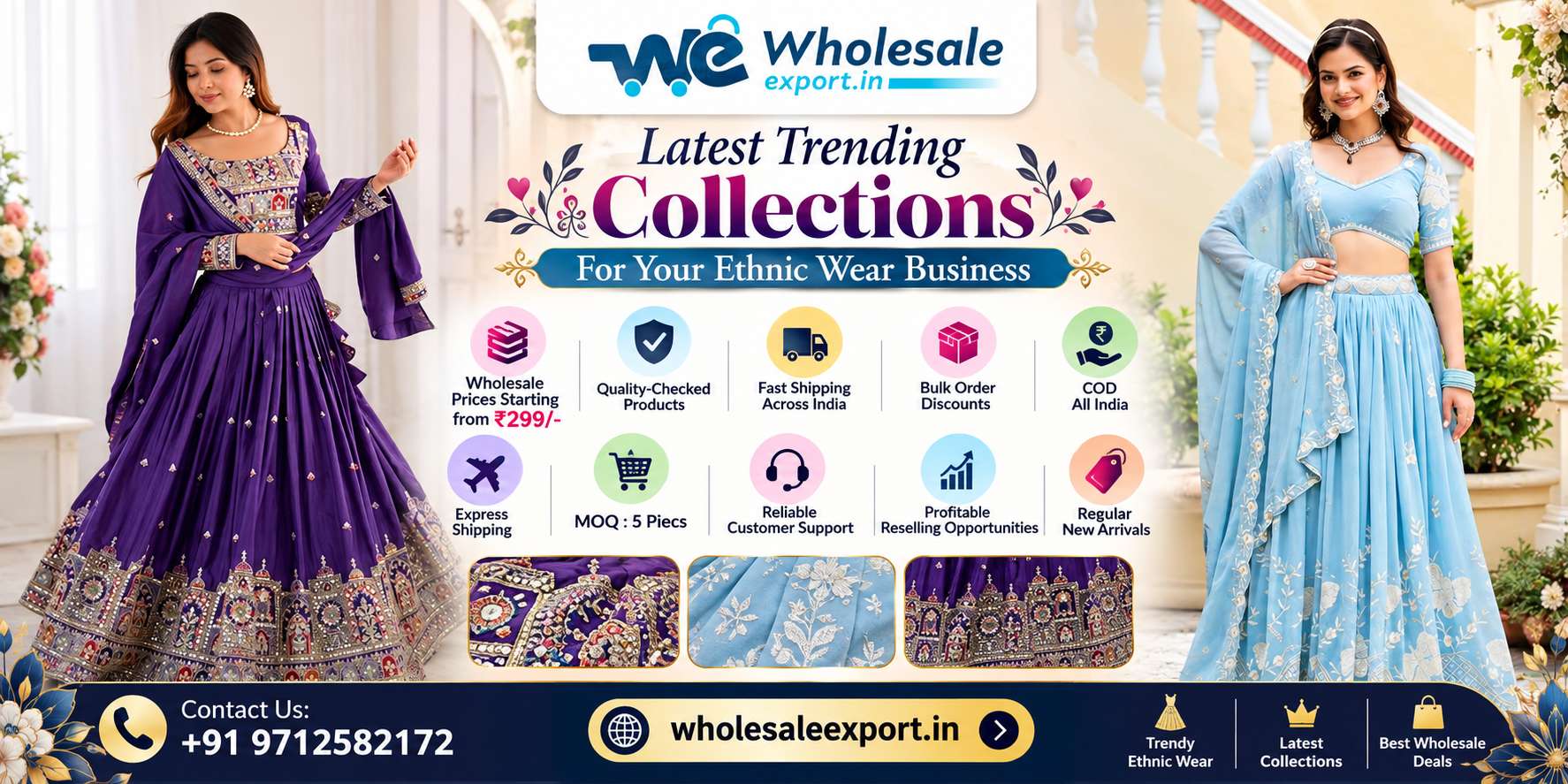
How to Choose a Reliable Long-Term Wholesale Supplier for Your Business in 2026
How to Choose a Reliable Long-Term Wholesale Supplier for Your Business in 2026
A successful wholesale relationship is built on much more than finding the lowest product rate. Retailers need consistent quality, fresh collections, dependable communication, realistic delivery commitments and a supplier who can continue supporting the business as order volumes grow. For fashion businesses in particular, the right sourcing partner can simplify purchasing, improve inventory planning and help retailers respond faster when customer demand changes.
Introduction
Choosing a reliable long-term wholesale supplier is one of the most important sourcing decisions for Home-Based Sellers, Shop Owners, Boutique Owners, Showroom Owners, Resellers and Wholesale Buyers. The supplier affects not only your buying price, but also product quality, stock availability, delivery planning and ultimately the experience you provide to your customers.
In women's ethnic wear, this relationship becomes even more important because collections change frequently. Sarees, lehenga choli, kurtis, kurti sets, dress materials, Pakistani suits, salwar suits and other fashion categories can move quickly according to festivals, wedding seasons, social-media trends and regional demand.
A retailer who repeatedly changes suppliers only to save a small amount on each order may face inconsistent products, uncertain stock and complicated purchasing. In contrast, building relationships with dependable wholesale sources can make repeat ordering more systematic.
Surat remains an important sourcing destination for women's textiles and ethnic wear. The broader surat textile market ecosystem, including Ring Road, Sahara Darwaza and surrounding textile areas, connects retailers with trading, processing, distribution and manufacturing businesses. Digital platforms such as Wholesaleexport.in can also help business buyers explore collections without depending entirely on repeated physical market visits.
Start by Defining What You Need From a Wholesale Supplier
Before comparing suppliers, define your own business requirements. A supplier that works well for a large showroom may not necessarily be the most practical choice for a new Instagram reseller. Order quantity, customer segment, product category and buying frequency should influence the decision.
Identify Your Main Product Categories
Start with the categories that generate or are expected to generate most of your business. If you primarily sell lehengas, sarees and festive suits, a supplier with strong availability in those categories may be more valuable than a general wholesaler carrying hundreds of unrelated products.
Similarly, Boutique Owners may prioritize distinctive collections and premium designs, while high-volume Resellers may require fast-moving products at competitive wholesale rates.
Know Your Customer Price Range
Your supplier should have products suitable for the amount your customers are willing to spend. A business serving value-conscious buyers needs a different sourcing structure from a premium boutique.
Before confirming a supplier, compare the wholesale price with your expected selling rate and additional expenses. Transportation, packaging, marketing and customer delivery can all affect the margin available on a product.
Estimate Your Regular Order Quantity
Wholesale terms often depend on quantity. Understand whether your business generally purchases smaller catalogue quantities, medium-sized repeat orders or large bulk quantities.
A wholesale clothing supplier should ideally be able to support the current scale of your business while also offering a practical path as your purchasing volume increases.
Check Product Quality Before Building a Long-Term Relationship
Competitive pricing can attract the first order, but product quality influences whether the relationship continues. A dependable supplier should provide products that reasonably match the quality and specifications communicated during purchasing.
Evaluate Fabric and Finishing
For ethnic wear, buyers can evaluate fabric, stitching where applicable, embroidery, print quality, borders, embellishments, colour combinations and overall finishing according to the product category.
The expected quality should also match the price segment. An affordable fast-moving product and a premium boutique collection cannot be judged by exactly the same standard, but both should provide suitable value for their stated positioning.
Look for Consistency Across Repeat Orders
A single good order does not automatically establish long-term reliability. Repeat purchasing provides a better opportunity to understand whether quality remains reasonably consistent across different catalogues and batches.
This is especially important for retailers building their own reputation. Your customer deals with your business, not your upstream supplier. If quality changes unexpectedly, the retailer often handles the resulting customer dissatisfaction.
Premium Product Quality Can Support Repeat Customers
Premium product quality does not necessarily mean purchasing only expensive merchandise. It means choosing products that provide appropriate quality and presentation for their price segment.
Customers who receive products consistent with what they were shown are more likely to trust the retailer for future purchases. That repeat relationship can become more valuable than maximizing the margin on a single order.
Compare Wholesale Price With Total Business Value
Price is important, but the cheapest supplier is not automatically the most economical supplier. Retailers should consider the complete value of the relationship.
Suppose one supplier offers a slightly lower rate but has inconsistent availability and communication, while another provides regular new collections, dependable dispatch and clearer product information. The second relationship may save considerable time and operational effort even if some products cost slightly more.
Calculate the Real Landed Cost
When comparing wholesale rates, add transportation and other applicable purchasing expenses. For export orders, buyers may also need to consider freight and destination-related costs.
The landed cost gives a more useful comparison than the supplier's quoted product price alone. It helps retailers understand what the inventory actually costs by the time it is ready to sell.
Do Not Sacrifice Sellability for a Small Price Difference
A ₹20 or ₹50 saving on a product provides little benefit if the design moves significantly slower than a slightly more expensive alternative. Fashion retailers should compare expected demand alongside cost.
Stock turnover matters because money invested in unsold products cannot easily be used for fresh collections. A good sourcing decision therefore considers price, quality and likely sales velocity together.
Check Whether the Supplier Provides Regular New Collections
Fashion businesses need freshness. Customers following a boutique, Instagram seller or retail shop expect new designs periodically, particularly around festivals and wedding seasons.
A reliable long-term wholesale supplier should have a practical system for introducing and communicating new products. This does not mean the retailer must buy every new catalogue. It means buyers should have enough options to refresh their inventory when required.
Fresh Stock Helps Online Sellers Create Content
New products also provide marketing material. Every new catalogue can become Instagram Reels, WhatsApp updates, website listings, Stories and direct customer communication.
For Home-Based Sellers and Resellers, this can be particularly useful because product freshness and content freshness often work together.
Ask About Restock Possibilities
When a collection performs strongly, buyers may want additional quantities. Ask whether popular products are typically restocked or whether most catalogues are available only for a limited period.
No supplier can guarantee that every fast-moving design will remain available. However, clear stock communication helps retailers make better purchasing decisions.
Evaluate Communication Before Increasing Your Orders
Communication becomes more important as order values increase. Buyers should know how enquiries, stock confirmation, payment information, dispatch updates and post-purchase issues are handled.
Look for Clear Product Information
Wholesale buyers need enough information to make purchasing decisions. Depending on the product, this may include fabric, available designs, catalogue quantity, price and other relevant specifications.
Clear information is especially valuable for online buyers who cannot inspect every product physically before ordering.
Observe Response Quality, Not Just Response Speed
A fast reply is useful, but an accurate reply is more important. Suppliers should avoid making unrealistic promises simply to secure an order.
For long-term purchasing, honest communication about stock availability and expected dispatch can be more valuable than an immediate answer that later changes.
Check Dispatch and Shipping Reliability
Retailers often plan promotions around expected stock arrival. Delayed dispatch can therefore affect more than logistics; it can reduce the available selling period, particularly for seasonal products.
Before increasing purchasing volume, observe how consistently orders are processed and whether dispatch communication is reasonably clear.
Festival Orders Require Extra Planning
During busy festive and wedding periods, product demand and logistics volumes can increase. Retailers should place time-sensitive orders earlier instead of assuming normal purchasing timelines will always remain unchanged.
A good supplier relationship helps with planning, but Boutique Owners and Wholesale Buyers should still maintain realistic buffers for important seasonal collections.
International Buyers Need a Longer Planning Window
Businesses sourcing for customers in countries such as Nepal, Australia and USA should account for the additional stages involved in international supply.
Export buyers should work backwards from the date their customers need the merchandise, allowing sufficient time for wholesale sourcing, packing, dispatch, transportation and local selling preparation.
Why Surat Matters When Choosing a Wholesale Supplier
Surat's large textile ecosystem provides business buyers with access to multiple women's fashion categories and price segments. The commercial network around the surat textile market, Ring Road and Sahara Darwaza connects wholesalers, traders and manufacturing-related businesses serving buyers from different regions.
For retailers, this concentration can make product comparison and category expansion easier. A business that begins with sarees or suits may later explore lehengas, kurtis, dress materials and other complementary products according to customer demand.
Ring Road and Wholesale Textile Sourcing
Ring Road is widely associated with Surat's textile trade. Buyers sourcing through the wider area can encounter numerous product categories, suppliers and wholesale businesses.
The number of choices also makes supplier evaluation more important. Retailers should not select a long-term source solely because it operates in a major textile location. Product quality, communication, price structure and service still need to be assessed individually.
Sahara Darwaza and the Wider Textile Ecosystem
Sahara Darwaza is another important reference point within Surat's textile trading environment. The surrounding market ecosystem supports buyers sourcing products across different wholesale segments.
For businesses outside Surat, Wholesaleexport.in provides an online route to explore wholesale women's ethnic wear collections without requiring a physical sourcing visit for every purchasing cycle.
Test a Wholesale Supplier Before Making Large Commitments
One of the most practical ways to evaluate a potential long-term supplier is to build the relationship gradually. Instead of moving a large percentage of your purchasing immediately, begin with orders appropriate to your business and observe the complete experience.
Check whether the products reasonably match the information provided, whether communication remains clear after payment, how dispatch is handled and whether the supplier responds professionally if an issue arises.
Judge the Complete Order Cycle
A wholesale transaction does not finish when payment is made. The complete cycle includes product selection, confirmation, payment, packing, dispatch, delivery and the retailer's eventual customer response.
Several successful order cycles provide stronger evidence of reliability than a single transaction. This is particularly important before increasing order values substantially.
Maintain Supplier Performance Notes
Business buyers can maintain simple records covering product quality, average dispatch experience, communication and customer feedback. This creates an objective basis for deciding which suppliers deserve a larger share of future purchasing.
The next stage of selecting a reliable long-term wholesale supplier is to evaluate scalability, category depth, payment and ordering terms, supplier risk, international sourcing support and the value of a stable B2B relationship as your business grows in 2026.
Check Whether the Supplier Can Scale With Your Business
A supplier may work perfectly when you are purchasing a few catalogues, but the real test comes when your order volume increases. A long-term sourcing partner should have the operational ability to support larger and more frequent orders without creating unnecessary complications.
For growing Boutique Owners, Showroom Owners and Wholesale Buyers, scalability means more than quantity. It includes access to fresh collections, efficient order handling, consistent communication and the ability to support different product categories as the retailer expands.
Discuss Future Volume Before You Reach It
If your current orders are small but your business is growing, understand how the supplier handles larger quantities. Ask about bulk availability, catalogue requirements, wholesale pricing structure and whether terms change at higher order values.
This helps avoid discovering later that a supplier who works well for small purchases cannot support your future buying pattern.
Category Depth Can Reduce Sourcing Complexity
A supplier or wholesale platform offering multiple relevant categories can simplify purchasing. Instead of coordinating with many separate sources for lehengas, sarees, suits and other women's ethnic wear, buyers may be able to consolidate part of their sourcing.
However, convenience should not replace product evaluation. Each category should still be selected according to quality, customer demand and price.
Understand Wholesale Payment and Ordering Terms Clearly
Long-term wholesale relationships work better when both parties understand the ordering process. Before increasing your purchases, make sure payment terms, minimum order requirements, dispatch procedures and relevant policies are clear.
Confirm MOQ Before Building Your Buying Plan
Minimum order quantity can influence working capital significantly. Home-Based Sellers and smaller Resellers may prefer manageable quantities, while established shops and Wholesale Buyers can usually work with deeper inventory.
Do not buy excessive stock merely to meet an MOQ unless the products match your expected sales. The additional discount from a larger quantity may not compensate for money remaining blocked in slow-moving inventory.
Understand Policies Before Placing the Order
Buyers should review applicable payment, shipping, COD, damage or defect claim and other ordering terms before completing a transaction. These terms can vary according to supplier, product, location and order value.
Clear expectations reduce misunderstandings and make repeat purchasing more efficient.
Look for a Supplier Who Understands Fashion Trends
Women's ethnic wear changes continuously. Traditional categories remain important, but colours, silhouettes, prints, embroidery and styling evolve from season to season.
A reliable long-term wholesale supplier should provide access to current products while still maintaining categories with proven demand. In 2026, retailers increasingly need this balance because customers discover fashion through both physical markets and social media.
Trends Should Support Sales, Not Control Every Purchase
A viral product can create rapid demand, but not every trend deserves a large inventory investment. Retailers should test trend-driven collections and increase quantities only after seeing genuine customer response.
A wholesale source with regular new arrivals gives retailers the flexibility to participate in trends without depending entirely on one seasonal catalogue.
Proven Categories Still Matter
Core products such as sarees, salwar suits, dress materials, kurtis and selected festive wear can continue to generate business even while individual fashion trends change.
A balanced buying strategy combines dependable categories with carefully selected new styles, helping retailers maintain continuity while keeping their assortment fresh.
Evaluate a Supplier for Festival and Wedding Season Buying
Festival and wedding periods can expose weaknesses in a sourcing relationship because both product demand and order volumes may increase. A supplier who performs consistently during busy periods can become particularly valuable to a growing retailer.
Retailers should still avoid depending on last-minute sourcing. Place important seasonal orders with enough time for confirmation, dispatch, transportation, receiving and customer promotion.
Early Access to Collections Creates a Longer Selling Window
Receiving festival products early gives the retailer time to create photographs, Reels, WhatsApp campaigns and in-store displays before peak demand begins.
It also provides an opportunity to identify early bestsellers. If a particular product performs strongly and additional stock remains available, the retailer may still have time to reorder.
Stock Availability Matters as Much as Variety
A supplier may show a large catalogue, but retailers should also consider how efficiently availability is confirmed. Fashion stock can move quickly, particularly during peak seasons.
Clear availability information helps buyers avoid promoting products that can no longer be supplied.
Internal Linking Section for Wholesale Buyers
Businesses developing their festive inventory can explore the wholesale lehenga market in Surat collection to compare designs and price segments suitable for boutiques, shops, showrooms and Resellers.
Retailers looking to expand beyond lehengas can also explore wholesale Pakistani suits for customers interested in distinctive suit designs and contemporary ethnic wear.
Adding categories gradually allows retailers to test customer response before allocating a larger percentage of working capital to a new product segment.
Do Not Depend Completely on One Supplier Without Risk Planning
A strong supplier relationship can simplify business, but retailers should still manage sourcing risk. Unexpected stock shortages, transportation issues, production delays or seasonal demand can affect even established wholesale relationships.
Keep Backup Options for Critical Categories
For your most important product categories, understanding alternative sourcing options can protect the business if the regular source temporarily cannot supply the required stock.
This does not mean constantly shifting orders between suppliers. The objective is simply to avoid a situation where one temporary supply problem stops an important category completely.
Do Not Split Every Small Order Across Too Many Suppliers
The opposite approach can also create problems. Working with too many sources may make quality, payments, transportation and inventory management unnecessarily complicated.
Many retailers benefit from developing a smaller group of trusted sources while maintaining alternatives for specific categories or unexpected situations.
How to Compare Wholesale Suppliers Objectively
Supplier selection becomes easier when buyers use measurable criteria rather than making decisions only from catalogue appearance or the lowest quoted rate.
Create a simple supplier evaluation covering product quality, pricing, collection freshness, communication, stock confirmation, dispatch experience and customer response to the products.
Compare Product Sell-Through
The most useful supplier is not necessarily the one providing the cheapest stock. Track how quickly products purchased from different sources actually sell.
A slightly higher-priced collection that repeatedly converts into customer orders can contribute more value than cheaper merchandise that remains unsold.
Compare Repeat Customer Feedback
Retailers can also monitor which collections generate repeat purchases or positive customer responses. Over time, this helps identify suppliers whose products match the retailer's specific market.
Using real sales data makes future wholesale purchasing more precise and reduces dependence on guesswork.
Choosing a Wholesale Supplier for Export Business
Businesses purchasing for export need additional considerations because the distance between supplier and final market is greater. Product quality, packing, shipment planning and communication become particularly important.
Wholesale Buyers serving markets such as Nepal, Australia and the USA should choose collections according to customers in those destinations rather than assuming the same assortment will perform equally everywhere.
Plan According to Landed Cost
For international business, compare the wholesale product price with freight and other applicable destination-related expenses. The complete landed cost determines whether the product leaves enough room for the intended resale margin.
This calculation is particularly important for lower-priced products, where logistics can represent a meaningful portion of the final cost.
Allow Extra Time for Seasonal Export Orders
If products are intended for festivals, weddings or other date-sensitive selling periods, international buyers should order earlier. The stock needs enough time for sourcing, packing, dispatch, transportation and local distribution before customers begin shopping.
A dependable supplier can support the sourcing side of this process, but retailers should still build sufficient logistical buffer into their buying calendar.
Why Surat Remains Relevant for Long-Term Wholesale Sourcing
The scale of the surat textile market provides access to a broad textile ecosystem rather than a single product category. Ring Road, Sahara Darwaza and surrounding commercial areas are associated with textile trading, wholesale distribution and manufacturing activity.
For growing businesses, this creates opportunities to source according to different price points and customer segments. Retailers can develop relationships with suppliers relevant to their core categories while exploring new collections as demand changes.
Wholesaleexport.in gives buyers an online route to explore women's ethnic wear sourcing, which can be particularly useful for businesses located outside Surat or international buyers who cannot visit the market for every purchase.
Vastralife Wholesale and Export Experience Since 2017
Vastralife brings wholesale and export experience since 2017, supported by industry expertise in women's ethnic wear and B2B sourcing. Experience in the wholesale market helps in understanding the different purchasing requirements of Home-Based Sellers, Shop Owners, Boutique Owners, Showroom Owners, Resellers and larger Wholesale Buyers.
For a smaller seller, flexibility and fresh collections may be particularly important. For larger buyers, product depth, repeat sourcing and bulk-order requirements can become more significant as purchasing volume increases.
Across these business models, premium product quality, practical wholesale pricing and access to new arrivals can support a more consistent sourcing relationship.
Warning Signs to Check Before Increasing Wholesale Orders
Buyers should be cautious when important product or ordering information remains unclear. Large orders should normally follow successful smaller transactions rather than being based only on promotional claims.
Unclear Product Information
If essential information about fabric, product composition, catalogue quantity or price remains unclear, request clarification before purchasing. Assumptions can create problems when products reach your customers.
Unrealistic Availability or Delivery Promises
Fashion inventory changes quickly. Be cautious when a supplier makes absolute stock or delivery promises without first checking availability and logistics.
A professional supplier should communicate realistic expectations rather than simply providing the answer most likely to secure an immediate order.
Large Price Differences Without a Clear Reason
If one quotation is dramatically below comparable products, examine fabric, workmanship, product specifications and ordering conditions before assuming it represents a better deal.
The objective is not to avoid low prices; it is to understand what you are purchasing and whether the product fits your customer expectations.
Customer FAQs
1. How do I choose a reliable long-term wholesale supplier?
Compare product quality, wholesale price, stock availability, communication, dispatch experience, ordering terms and the actual sell-through of products purchased. Several successful order cycles provide stronger evidence than one transaction.
2. Should I always choose the cheapest wholesale supplier?
No. Price is important, but quality, sellability, communication and service also affect the real cost of sourcing. Compare total business value rather than only the quoted rate.
3. Should I test a supplier before placing a bulk order?
For a new relationship, beginning with an order appropriate to your business can help you evaluate the complete buying experience before substantially increasing your purchasing commitment.
4. What should I check in a women's clothing wholesaler?
Check relevant product categories, fabric and finishing, pricing, new-arrival frequency, minimum ordering requirements, stock confirmation, dispatch processes and applicable policies.
5. Is Surat suitable for wholesale ethnic wear sourcing?
Surat has an extensive textile trading and manufacturing ecosystem, with Ring Road, Sahara Darwaza and the wider textile market serving buyers across multiple women's fashion categories.
6. Can Home-Based Sellers buy from wholesale suppliers?
Yes, depending on the supplier's current MOQ and ordering terms. Home-Based Sellers should select quantities that match their working capital and realistic customer demand.
7. How important are regular new arrivals?
Regular collections can help fashion businesses keep inventory fresh and provide new content for customers. Retailers should still buy selectively instead of purchasing every new catalogue.
8. Can I use the same wholesale supplier for export orders?
This depends on the supplier's export capabilities and terms. International buyers should also consider freight, landed cost, timelines and destination requirements before confirming orders.
9. How many wholesale suppliers should a retailer use?
There is no fixed number. Many businesses benefit from developing dependable core relationships while keeping suitable backup sources for important categories or supply interruptions.
10. What makes a supplier suitable for a long-term relationship?
Consistent product value, transparent communication, appropriate pricing, dependable order handling and the ability to support changing business requirements are important indicators of a sustainable wholesale relationship.
Build Your Long-Term Wholesale Sourcing With Wholesaleexport.in
Choosing a reliable long-term wholesale supplier in 2026 should be treated as a business decision rather than a search for the lowest rate. The strongest sourcing relationship is one that helps you purchase suitable products, maintain quality expectations, plan inventory confidently and serve customers consistently as your business grows.
Explore Latest Collections, competitive Wholesale Pricing and Trendy Ethnic Wear for Home-Based Sellers, Shop Owners, Boutique Owners, Showroom Owners, Resellers and Wholesale Buyers.
Wholesaleexport.in provides access to wholesale collections with Fast Shipping, COD Support where applicable, Bulk Order Deals according to current terms and Quality Products Starting From ₹299.
Contact Number: +91 9712582172
Website: wholesaleexport.in
A strong supplier relationship becomes more valuable with every successful buying cycle. Test carefully, measure product performance, communicate clearly and increase purchasing based on results. The goal is not simply to find someone who can supply your next order, but to develop a dependable sourcing system capable of supporting your retail, resale, boutique, showroom or export business over the long term.