


Direct Factory Saree Supplier in Surat: Wholesale Buying Guide 2026
Direct Factory Saree Supplier in Surat: Wholesale Buying Guide 2026
Surat remains one of the most important sourcing destinations for businesses that sell Indian sarees. Its vast textile ecosystem brings fabric processing, weaving, embroidery, printing, garment development, trading and distribution together within one commercial hub. For retailers, boutiques and resellers, sourcing closer to this ecosystem can provide access to wider selections, competitive rates and frequently changing designs that match current customer demand.
Introduction
Finding a reliable direct factory saree supplier in Surat has become a priority for many fashion businesses in 2026. Customers want more variety, retailers need workable margins, and fashion trends are changing faster because buyers discover new styles daily through Instagram, WhatsApp, YouTube and online marketplaces.
Surat has an important advantage in this environment. The city is connected with a huge textile supply chain covering yarn, fabrics, weaving, dyeing, printing, embroidery, finishing, saree development, manufacturing, wholesale trading and logistics. This gives professional buyers access to numerous saree categories and price segments.
However, the term “factory supplier” should be understood practically. Some businesses manufacture particular collections directly, while established wholesalers may source from multiple production units and brands. For many Shop Owners, Boutique Owners and Resellers, a supplier offering access to several dependable production sources can be more useful than dealing with a single factory producing only one category.
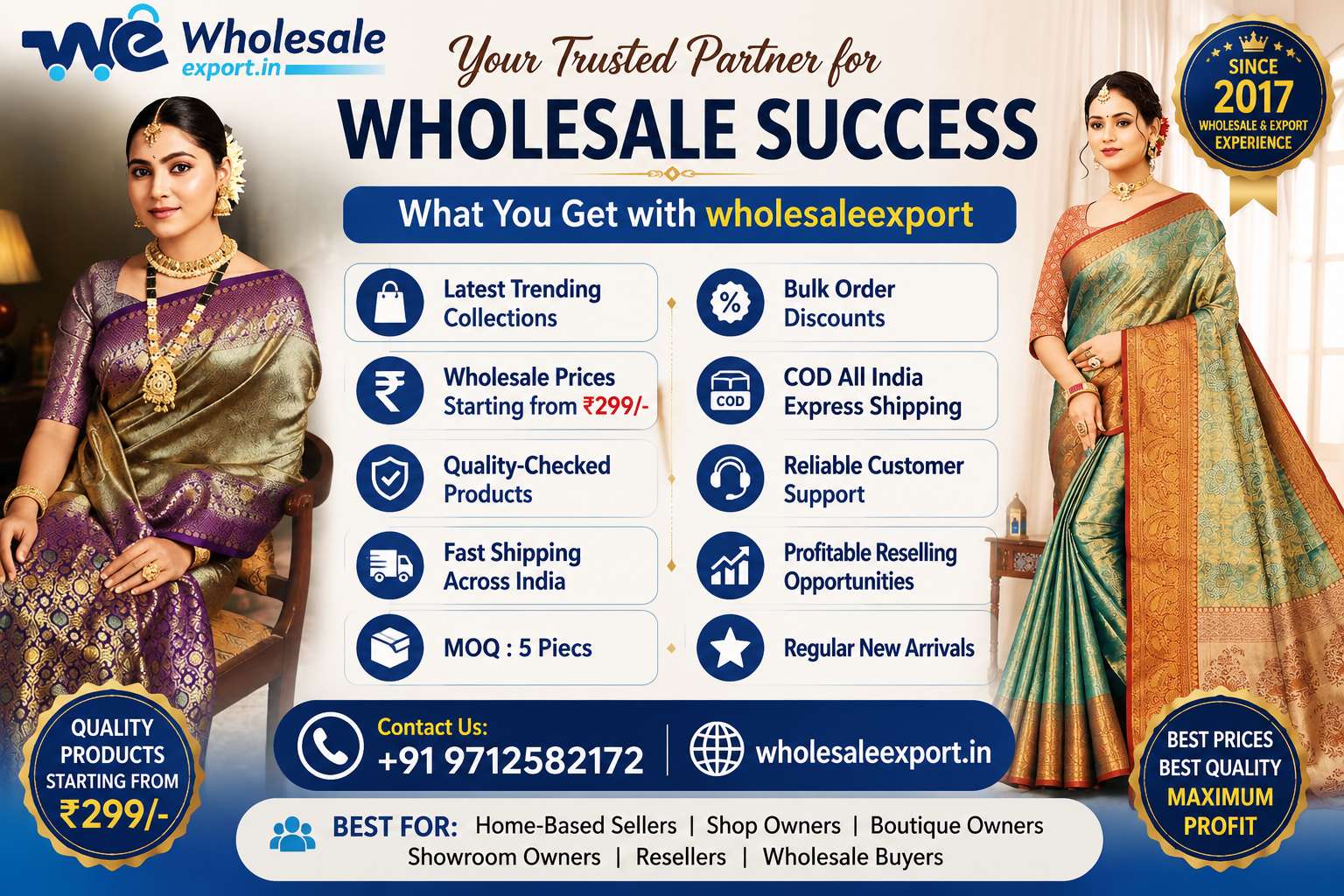
Wholesaleexport.in helps wholesale buyers explore Indian fashion and saree collections through an online sourcing environment. Vastralife's wholesale and export experience since 2017 brings industry knowledge developed through years of working with textile products, suppliers and different types of B2B buyers.
Why Surat Is a Major Saree Wholesale and Manufacturing Hub
Surat's importance in Indian textiles is not based on a single market or one type of saree. Its strength comes from the size and diversity of the overall textile ecosystem. Different stages of production and trading are closely connected, making the city commercially useful for buyers searching for both affordable and premium merchandise.
Businesses looking for saree manufacturers in Surat can find options across printed sarees, synthetic varieties, designer styles, embroidered products, festive collections, silk-look sarees and other commercially popular categories.
A Strong Textile Supply Chain
The ability to source fabric, process it, add embroidery or decorative work, finish products and distribute them through wholesale markets creates an efficient environment for saree development.
This interconnected system also helps the market respond quickly to changing trends. When particular colours, borders, fabrics or embellishment styles become popular, new collections can enter the wholesale market relatively quickly.
Variety for Different Retail Markets
A boutique serving wedding shoppers needs different inventory from a retailer selling affordable daily-wear sarees. Surat's scale makes it possible for buyers to explore products for multiple customer groups.
Home-Based Sellers can focus on manageable, visually attractive collections, while Showroom Owners and Wholesale Buyers can build deeper inventories across several price ranges.
Understanding Direct Factory Saree Sourcing
When buyers search for a direct factory saree supplier in Surat, they usually want three things: better price, dependable quality and access to fresh designs. Buying closer to production can offer advantages, but buyers should understand how the supply chain actually works.
Direct Manufacturer Buying
A manufacturer may specialise in specific fabrics, weaving styles, printing processes or saree categories. Purchasing directly can be useful when a buyer requires larger quantities of a particular product and is comfortable with the manufacturer's MOQ.
For established retailers, distributors and high-volume buyers, direct saree manufacturing in Surat can provide opportunities for repeat orders and focused sourcing.
Multi-Brand Wholesale Sourcing
Smaller retailers and boutiques often need variety rather than hundreds of pieces from one production line. In such situations, an experienced wholesaler connected with several manufacturers can provide greater flexibility.
A buyer might source Banarasi-style sarees, festive sarees, printed products and designer collections through one wholesale channel instead of developing separate relationships with every production unit.
This can reduce purchasing complexity while still providing access to Surat's wider manufacturing network.
What Buyers Should Expect from a Reliable Saree Supplier
Wholesale purchasing involves more than receiving a catalogue and asking for the lowest rate. A professional supplier should provide enough information for the buyer to make a sensible commercial decision.
Clear Product Information
Buyers should understand the fabric category, work, design, catalogue quantity and other relevant details before ordering. This information helps retailers decide whether a collection suits their customers.
For example, a premium festive saree should not be evaluated using the same criteria as an affordable daily-wear saree. Each category has its own quality and price expectations.
Commercially Sensible Wholesale Pricing
A low buying rate is valuable only when the product has resale potential. Retailers should evaluate wholesale cost together with fabric, design, finishing and expected customer demand.
The objective should be profitable inventory rather than simply purchasing the cheapest available stock.
Regular New Collections
A reliable Surat saree wholesaler should understand that retailers need freshness. Customers repeatedly visiting the same shop or checking a reseller's online updates expect new designs.
Regular new arrivals can help sellers maintain customer interest and prepare for festivals, weddings and seasonal demand.
Surat Textile Market: Where Wholesale Fashion Comes Together
The surat textile market is not one single building. It represents a broad commercial ecosystem containing numerous textile markets, traders, wholesalers, manufacturers and service businesses.
Retailers from different Indian states have traditionally travelled to Surat to explore products and negotiate purchases. Physical sourcing remains useful, particularly for high-volume buyers, but online wholesale has made the same market ecosystem more accessible to businesses that cannot travel frequently.
Ring Road Textile Market Area
ring road is one of the most familiar locations associated with Surat's textile trade. Numerous wholesale textile markets operate around this area, making it an important destination for buyers sourcing sarees, dress materials and women's garments.
Visiting multiple markets allows buyers to compare products, but it can require significant time. Retailers located outside Gujarat may also have travel, accommodation and transportation expenses.
Online sourcing through platforms such as Wholesaleexport.in can help reduce this dependency by allowing buyers to discover products remotely.
Sahara Darwaza and Nearby Wholesale Markets
sahara darwaza is another commonly recognised location within Surat's textile trading environment. Buyers searching for wholesale clothing and saree suppliers frequently encounter businesses connected with this broader area.
For new buyers, understanding these geographical references is useful because it provides context about Surat's textile infrastructure. However, supplier selection should still be based on product suitability, business reliability and service rather than location alone.
Popular Saree Categories to Source from Surat in 2026
The strongest advantage of wholesale sarees in Surat is variety. Buyers can explore products for daily use, office wear, festivals, weddings, gifting and premium retail customers.
Banarasi Sarees
Banarasi-inspired sarees remain popular for weddings and festive occasions because of their rich traditional appearance. Buyers can find numerous colour combinations, zari-inspired patterns and decorative styles designed for different price segments.
For boutiques, these sarees can provide a traditional category that remains relevant across multiple seasons rather than depending entirely on short-lived fashion trends.
Designer Sarees
Designer sarees wholesale collections can include embroidery, sequins, lace borders, digital prints, decorative blouses and contemporary styling. These products are particularly useful for boutiques and occasion-wear stores.
Retailers should select designs according to local customer preferences. A heavily embellished saree may perform well in a wedding-focused boutique but move more slowly in a store dominated by daily-wear customers.
Silk and Silk-Look Sarees
Traditional-looking silk collections continue to attract customers during weddings, religious occasions and festivals. Different fabric constructions and price levels allow retailers to target both value-oriented and premium customers.
Buyers should examine fabric specifications rather than relying only on visual appearance when comparing products.
Printed Sarees
Printed sarees can be commercially attractive for sellers targeting everyday fashion and affordable price points. Floral prints, geometric patterns, traditional motifs and contemporary designs provide numerous merchandising possibilities.
Because daily-wear categories can rotate faster than expensive occasion merchandise, printed sarees may provide useful repeat-selling opportunities for many retailers.
.jpeg)
How to Compare Saree Wholesale Prices in Surat
Buyers searching for a direct factory saree supplier in Surat frequently begin with price comparison. This is understandable because purchase cost affects retail margins, but comparing only the catalogue rate can lead to poor sourcing decisions.
Two sarees with similar photographs may differ in fabric, weaving, embroidery, finishing, blouse material or overall workmanship. Wholesale buyers should therefore compare equivalent specifications whenever possible.
Understand the Complete Product Value
A ₹500 saree that generates quick customer demand may be more commercially useful than a ₹400 saree that remains unsold. Likewise, a premium saree with a higher purchase rate may generate an attractive absolute profit when customers recognise its quality.
The right saree wholesale price is therefore not necessarily the lowest price. It is the cost that gives your business an appropriate balance between quality, customer demand and resale margin.
Calculate Landed Cost
Retailers should consider all relevant costs associated with getting the merchandise ready for sale. Depending on the order, these may include applicable taxes, shipping and other business expenses.
For international buyers, freight and destination-related charges become particularly important. Calculate these costs before deciding the final retail price.
How Boutique Owners Should Select Saree Inventory
Boutique customers often expect products that feel more selective than general mass-market inventory. Boutique Owners should therefore build collections according to a clear customer profile rather than purchasing every new catalogue they see.
Know Your Average Customer Budget
If most customers purchase between specific price points, allocate the majority of inventory to that range while keeping a smaller selection above and below it.
This improves the likelihood that customers will find suitable products without forcing the boutique to hold excessive inventory.
Create Visual Variety
A boutique display becomes more attractive when customers can see variation in colours, fabrics and styling. Combining traditional sarees with contemporary designer options can help create a more interesting assortment.
Retailers can also plan inventory around weddings, festive seasons and local cultural events when saree demand is likely to increase.
Saree Sourcing for Home-Based Sellers and Resellers
Home-Based Sellers do not necessarily need the same inventory depth as a showroom. Their advantage is flexibility. They can test selected products, market them through social media and increase purchasing as customer response becomes clearer.
For new Resellers, visually appealing sarees with commercially accessible pricing can be easier to market through WhatsApp, Instagram and personal customer networks.
Start with Controlled Inventory
A common mistake is purchasing too many pieces before understanding customer demand. New sellers should protect working capital by testing categories and recording which designs receive genuine enquiries.
Track What Customers Actually Buy
Likes and messages are useful indicators, but completed sales provide better purchasing data. Record popular colours, price ranges and saree types so future wholesale orders become increasingly accurate.
Wholesale Saree Opportunities for International Buyers
Surat sarees are also relevant to overseas boutiques serving South Asian communities and customers interested in Indian fashion. Wholesale buyers in USA, Singapore and New Zealand can build collections around festivals, weddings, cultural celebrations and occasion wear.
Choose Products with Suitable Export Value
International buyers should consider the relationship between product value and shipping cost. Very low-margin merchandise may become less attractive once international logistics are included.
Selected festive sarees, designer products and premium-looking traditional collections can provide stronger retail positioning when the destination market supports the selling price.
Understand Local Customer Preferences
Indian fashion demand differs between markets. Colours, fabrics, weather, sizing expectations and customer budgets can vary. Overseas buyers should use local sales data when selecting their next export saree collection.
Why Industry Experience Matters in Saree Wholesale
Saree sourcing requires knowledge of more than product photography. Fabrics, finishing, fashion trends, seasonal demand and wholesale economics all influence whether a collection performs successfully at retail.
Vastralife's wholesale and export experience since 2017 brings practical industry expertise developed through years of involvement with textile sourcing and wholesale buyers.
That experience is relevant when evaluating products from Surat's enormous textile ecosystem. Rather than simply offering more products, the goal is to provide buyers with access to commercially useful collections and premium product quality across suitable price segments.
How to Verify a Direct Factory Saree Supplier
Before placing substantial orders, buyers should evaluate the supplier carefully. Check available business information, product details, ordering terms, communication and payment procedures.
A professional supplier should be able to explain relevant product information and provide clear guidance about the ordering process.
Do Not Depend Only on Social Media
Instagram and Facebook are useful for discovering products, but follower counts should not be treated as proof of wholesale reliability. Look at the complete business presence.
Ask Commercial Questions
Before purchasing, understand the fabric, catalogue quantity, MOQ, applicable price, dispatch terms and other relevant details. Clear questions help reduce misunderstandings and allow you to compare suppliers more effectively.
Plan Inventory According to Retail Demand
The most successful sourcing strategy is not necessarily buying the largest quantity at the lowest rate. It is buying products that can rotate through your business efficiently.
Daily-wear products can create regular cash flow, while festive and wedding sarees can generate higher-value transactions. Maintaining a thoughtful mix helps retailers serve different customers without placing excessive capital into one category.
Wholesaleexport.in can help buyers explore multiple fashion segments while sourcing according to their business size, customer profile and purchasing requirements.
Build a Profitable Saree Product Mix
Once a dependable sourcing channel has been identified, the next step is deciding what to purchase. A profitable saree business rarely depends on a single fabric, design or price category. Customers have different budgets and shop for different occasions, so retailers benefit from maintaining a balanced assortment.
A practical collection can combine affordable daily-wear sarees, mid-range festive styles and selected premium products. The exact ratio should depend on the customers already purchasing from your store rather than on general fashion trends alone.
Daily-Wear Sarees for Regular Sales
Daily-wear collections can provide steady inventory movement because customers purchase them for regular use, office wear, gifting and casual occasions. Comfortable fabrics, wearable colours and affordable price points are particularly important in this segment.
For Shop Owners and Home-Based Sellers, these products can provide repeat-selling opportunities throughout the year instead of depending exclusively on wedding or festival seasons.
Festive Sarees for Seasonal Demand
Festivals create opportunities for brighter colours, decorative borders, zari-inspired patterns, embroidery and richer-looking fabrics. Retailers can increase their festive assortment ahead of important selling periods while continuing to maintain basic inventory.
The objective is to have enough variety when demand increases without overstocking products after the season ends.
Premium Sarees for Higher-Value Customers
Boutique Owners and Showroom Owners can reserve part of their buying budget for premium sarees. Customers purchasing for weddings, family functions and important celebrations may prioritise design and quality over the lowest possible price.
A smaller collection of carefully selected premium products can enhance a store's overall presentation and create higher-value transactions.
Internal Linking for Better Saree and Fashion Sourcing
Buyers researching traditional wedding and festive styles can explore Banarasi saree collections to compare colours, designs and wholesale options suitable for different retail customers.
Retailers who want to expand beyond sarees can also research the Ahmedabad kurti wholesale market category and evaluate whether kurtis or coordinated sets can complement their existing women's fashion inventory.
Using relevant product and category pages helps buyers move beyond one collection and understand the broader assortment available for their business. This is particularly useful for sellers who want to increase average customer order value through complementary fashion categories.
How to Calculate Profit Before Buying Sarees in Bulk
Wholesale purchasing becomes more effective when retailers calculate potential margins before committing significant capital. The catalogue rate is only the starting point of this calculation.
Consider the product cost, applicable taxes, shipping, packaging and other expenses associated with preparing the saree for retail sale. International buyers should additionally account for freight and destination-specific costs.
Do Not Calculate Margin from Product Cost Alone
Suppose a saree has an attractive wholesale rate but incurs additional transportation and selling expenses. Calculating the retail margin only against the original product cost would provide an inaccurate picture of profitability.
Instead, calculate the complete landed cost and then decide an appropriate retail selling price according to your market.
Inventory Rotation Matters as Much as Margin
A high margin percentage is useful only if the product sells. A lower-margin saree that sells several times during a season may contribute more profit than an expensive design that remains unsold.
Professional Wholesale Buyers therefore monitor both margin and inventory rotation when evaluating collections.
.jpeg)
How to Buy Sarees in Bulk from Surat
Purchasing wholesale sarees from Surat becomes easier when buyers follow a structured process. Start by identifying the type of merchandise required rather than asking a supplier to send every available catalogue.
Tell the supplier whether you need daily wear, festive products, wedding sarees, premium collections or a particular budget range. Clear requirements make product selection faster for both parties.
Decide Your Purchasing Budget
Before browsing hundreds of designs, determine how much capital you are comfortable allocating to the order. Divide that budget between fast-moving products and higher-value inventory according to your sales history.
New sellers should be particularly careful about locking too much working capital into untested collections.
Understand MOQ and Catalogue Requirements
Some wholesale saree collections may be supplied as complete catalogues, while others may have different quantity requirements. Buyers should understand MOQ before finalising their selection.
A large Showroom Owner may comfortably purchase deeper inventory, whereas a Home-Based Seller might prefer smaller quantities across more designs.
Confirm Current Availability
Popular wholesale products can move quickly. Confirm current availability and applicable rates when you are ready to order rather than assuming that an older catalogue remains unchanged.
This is particularly important during festival and wedding seasons when demand can increase rapidly.
Why Quality Checking Matters in Wholesale Sarees
Customers judge a retailer by the merchandise they receive, not by the retailer's original supplier. Product quality therefore has a direct impact on customer satisfaction and repeat business.
Fabric feel, weaving, embroidery, finishing, borders, blouse material and overall presentation can all influence perceived value. These expectations naturally vary according to the product's price segment.
Match Quality Expectations with Price Segment
An affordable saree and a premium wedding saree should not be judged using identical standards. What matters is whether the product provides suitable quality and value for the category in which it is being sold.
Transparent product positioning helps retailers set realistic customer expectations while protecting their reputation.
Check Products Promptly After Delivery
When wholesale stock arrives, inspect it according to the supplier's applicable policy. Keep appropriate records and follow any required procedure for reporting genuine issues.
For online orders, an unboxing video can provide useful evidence if an eligible issue needs to be reported.
Benefits of Online Saree Wholesale Buying in 2026
Physical textile markets remain highly relevant, but digital purchasing has changed how retailers interact with the surat textile market. Buyers no longer need to travel to ring road or sahara darwaza every time they want to see new collections.
Online wholesale platforms can help retailers monitor products more regularly, compare categories and place orders from their own location.
Save Travel Time
For retailers outside Gujarat, a sourcing trip involves transportation, accommodation and time away from their business. Online purchasing can reduce the frequency of these trips.
Access New Collections Faster
Fashion changes quickly. Online catalogues and product listings make it possible to discover fresh inventory as it becomes available instead of waiting until the next physical market visit.
Useful for Small and Growing Businesses
Home-Based Sellers and Resellers can access Surat's wholesale ecosystem without maintaining a buying office in the city. This has lowered geographical barriers for entrepreneurs entering the fashion business.
Wholesale Saree Export from Surat
The international market provides additional opportunities for Indian saree sellers. Boutiques and resellers in USA, Singapore and New Zealand can source Indian collections for weddings, festivals, cultural events and regular ethnic fashion demand.
A supplier with wholesale and export experience can be particularly valuable because international orders require additional planning compared with domestic purchases.
Choose Products with Strong Retail Value
Overseas buyers should consider shipping economics when selecting inventory. Products need enough retail value to support international freight and other applicable costs.
Traditional sarees, festive collections and premium-looking designs can be attractive where customers value authentic Indian styling and are comfortable with higher retail price points.
Build Collections for Local Overseas Demand
A successful collection in India may not perform identically in every international market. Retailers should track local preferences for colours, fabrics, designs and spending levels.
Over time, this sales information can make each subsequent saree export from India order more accurate.
Direct Factory Supplier vs Traditional Wholesaler
Buyers frequently assume that a direct factory saree supplier in Surat will always be better than a wholesaler. The reality depends on the business model.
A factory can be ideal when you require significant quantities of a particular type of saree. A wholesaler can be more practical when you need smaller quantities across many brands, styles or price points.
When Factory Sourcing Makes Sense
Factory sourcing can work well for high-volume buyers who understand exactly what they need. Larger repeat orders may also make it easier to maintain consistency within particular collections.
When Wholesale Sourcing Makes Sense
Boutiques and smaller retailers often benefit from variety. A multi-brand wholesale source can allow them to purchase different categories without meeting the production MOQ of several individual manufacturers.
Many successful businesses therefore use a combination of direct manufacturing sources and wholesale suppliers depending on their inventory requirements.
Why Wholesaleexport.in Can Support Saree Buyers
Wholesaleexport.in is designed for businesses searching for Indian fashion collections without depending entirely on repeated physical market visits. The platform can be useful for Home-Based Sellers, Shop Owners, Boutique Owners, Showroom Owners, Resellers and Wholesale Buyers exploring different wholesale categories.
For buyers looking for a direct factory saree supplier in Surat or access to products connected with Surat's broader sourcing ecosystem, online product discovery can make purchasing more convenient.
Vastralife Wholesale and Export Experience Since 2017
Vastralife has wholesale and export experience since 2017, supported by practical textile industry expertise. Years of involvement in the market provide an understanding of wholesale purchasing, fashion trends, supplier networks and buyer expectations.
This experience helps support a sourcing approach focused on commercially relevant products rather than simply displaying large numbers of designs.
Focus on Premium Product Quality
Quality is important at every price point. A practical wholesale business should aim to provide appropriate value according to the category, whether the buyer is purchasing affordable fast-moving products or premium occasion wear.
Wholesaleexport.in gives buyers an opportunity to explore products across different segments while planning inventory according to their own customers and budget.
Customer FAQs
1. Where can I find a direct factory saree supplier in Surat?
Surat has manufacturers, wholesalers and textile businesses across its major commercial textile areas. Buyers can source physically through the city's markets or explore online wholesale platforms such as Wholesaleexport.in for convenient product discovery.
2. Why is Surat famous for wholesale sarees?
Surat has an extensive textile supply chain covering fabric, weaving, processing, printing, embroidery, manufacturing and wholesale distribution. This ecosystem provides buyers with substantial product variety across multiple price segments.
3. Can I buy Surat sarees online at wholesale prices?
Yes. Online wholesale sourcing allows retailers and resellers to explore Surat-related collections remotely. Always check current product availability, MOQ, applicable rates and ordering terms before purchasing.
4. What sarees should a new reseller start with?
The best category depends on your customers. New sellers can consider a controlled assortment of affordable daily-wear sarees, festive designs and selected traditional products before increasing inventory based on actual sales.
5. Is buying directly from a saree manufacturer cheaper?
Direct manufacturer pricing can be attractive for suitable quantities, but manufacturers may have larger MOQ requirements or specialised product ranges. Wholesalers can sometimes offer greater variety and purchasing flexibility.
6. Which sarees are popular for boutiques?
Boutiques can consider designer sarees, Banarasi-inspired collections, festive products, silk-look styles and selected premium wedding sarees depending on their customer profile.
7. Can overseas buyers source sarees from Surat?
Yes. International boutiques and wholesale buyers can source Indian sarees for their markets. They should consider product cost, shipping, customs requirements and destination-specific expenses before ordering.
8. How do I verify a Surat saree supplier?
Check available business information, product details, wholesale terms, MOQ, communication and payment procedures. Avoid choosing a supplier solely because of a very low advertised price or social media follower count.
9. What should I check before ordering sarees in bulk?
Review fabric details, design, catalogue quantity, MOQ, wholesale rate, availability and applicable dispatch conditions. Also calculate your expected retail margin before committing significant capital.
10. Is Surat suitable for small Home-Based Sellers?
Yes. Online wholesale sourcing has made Surat's textile ecosystem more accessible to smaller businesses. Home-Based Sellers can begin with suitable inventory quantities and expand purchasing as customer demand develops.
Choose the Right Saree Supplier for Long-Term Business Growth
Successful wholesale sourcing is not about finding one attractive catalogue at the lowest possible rate. Retailers need a supply network capable of supporting changing customer demand, new fashion trends and commercially sensible inventory decisions.
Compare products according to quality, wholesale price, resale potential and expected inventory rotation. Build relationships with suppliers who communicate clearly and understand professional wholesale requirements.
Whether you operate a boutique, showroom, physical store or home-based reselling business, the right sourcing decisions can improve margins while reducing unnecessary inventory risk.
Start Your Wholesale Saree Sourcing Today
Explore Wholesaleexport.in to discover wholesale fashion and saree collections suitable for retailers, boutiques, resellers and bulk buyers looking for fresh Indian styles in 2026.
Latest Collections – Explore regularly updated sarees and women's fashion collections for changing customer demand.
Wholesale Pricing – Discover commercially focused wholesale rates for retailers, resellers and professional buyers.
Trendy Ethnic Wear – Explore sarees and other Indian fashion categories suitable for daily, festive and occasion-based selling.
Fast Shipping – Shipping and dispatch support is available for eligible orders and destinations.
COD Support – COD support is available for eligible India orders according to applicable order terms.
Bulk Order Deals – Contact the team when planning larger wholesale purchases and explore suitable bulk-order opportunities.
Quality Products Starting From ₹299 – Explore affordable fashion selections according to current product and collection availability.
Contact Number: +91 9712582172
Website: wholesaleexport.in
From the surat textile market to digital wholesale sourcing, the way retailers purchase sarees continues to evolve. Combining Surat's established textile and manufacturing ecosystem with convenient online product discovery can help businesses source more efficiently. Choose collections according to your customers, calculate your complete buying cost and work with experienced suppliers to build a stronger and more profitable saree business.