


Boutique Stock Selection Guide 2026: Best Wholesale Ethnic Wear for Profitable Boutique Business
Boutique Stock Selection Guide 2026: Best Wholesale Ethnic Wear for Profitable Boutique Business
Choosing attractive products is only one part of running a successful boutique. The bigger challenge is deciding which designs, categories, sizes and price ranges deserve space in your inventory. A carefully planned stock mix can improve rotation, protect working capital and give customers enough variety to keep returning for new arrivals.
Introduction
A boutique can have beautiful interiors, strong social media marketing and excellent customer service, but its performance ultimately depends on the products available for sale. Buying too much of one design can block capital, while buying too little variety can make a store look repetitive. This is why a practical boutique stock selection guide becomes valuable for both new and established fashion sellers.
In 2026, boutique purchasing is becoming more demand-driven. Customers frequently discover styles through Instagram, short videos, online marketplaces and fashion influencers before visiting a local shop. Boutique owners therefore need to balance current trends with evergreen ethnic wear that continues selling even after a particular social-media trend slows down.
For buyers sourcing from India, the surat textile market remains an important destination because of its broad textile ecosystem, variety of wholesalers and strong manufacturing network. Commercial textile areas around Ring Road and Sahara Darwaza give buyers access to numerous product categories, making Surat particularly useful for retailers who want multiple options without depending on a single fashion segment.
How to Select Boutique Stock That Has Better Selling Potential
The strongest boutique inventory is usually not built around personal preference alone. A design that a boutique owner personally loves may not necessarily be the design customers in that location will purchase. Stock selection should therefore combine customer profile, selling price, occasion, climate, local preferences and current demand.
Start With Your Actual Customer Profile
Before placing a wholesale boutique clothing order, identify who regularly buys from you. A boutique serving college-going customers will require a different assortment from a showroom serving wedding and festive buyers. Similarly, home-based sellers working through WhatsApp or Instagram may prefer products that photograph well and are easy to explain through catalog images.
For example, everyday buyers may respond better to cotton kurtis, printed kurti sets, tunics and comfortable ethnic sets. Festive customers can be offered embroidered suits, Anarkali styles, gowns, lehenga choli and premium dress materials. A store serving families may also create an additional revenue stream through kids ethnic wear wholesale collections.
Buy for Demand, Not Just for Variety
Having 100 different products does not automatically create a strong boutique. The better objective is to have the right products at the right price points. Analyse previous sales and identify which category, fabric, size and colour combinations move fastest.
A useful approach is to classify products into fast-moving basics, trend-led collections, festive stock and premium statement pieces. Fast-moving products help generate regular turnover, whereas premium collections can improve average billing value. Trend-led pieces create freshness and encourage customers to revisit the boutique.
Create a Balanced Wholesale Stock Mix
A balanced assortment helps prevent excessive dependency on one product category. Boutique owners can divide purchasing capital across several segments according to their own customer base instead of investing the entire budget in whichever product happens to be trending that week.
Daily and Regular Wear
Regular-use products can provide steady sales throughout the year. Cotton kurtis, rayon kurtis, short kurtis, tunics, straight-cut kurtis, printed sets and comfortable kurti-pant combinations can work well for repeat customers. These products are especially useful for boutiques where customers expect fresh options at accessible prices.
Home-Based Sellers and Resellers can also benefit from this segment because customers generally make purchasing decisions more quickly when the style is wearable and the selling price is approachable. Regular new arrivals can encourage repeat orders without requiring customers to wait for a festival or special event.
Festive and Occasion Wear
Festive inventory requires a different buying strategy. Instead of simply increasing quantity, focus on visual impact. Embroidery, zari details, decorative dupattas, rich fabrics, coordinated sets and statement silhouettes can create stronger festive presentation.
Popular ethnic wear wholesale choices can include Anarkali suits, designer kurti sets, lehenga choli, party-wear suits, gowns, festive dress materials and premium salwar suits. Shop Owners and Showroom Owners should begin festive sourcing sufficiently early so products can be photographed, promoted and displayed before demand reaches its peak.
Premium Boutique Collections
Premium customers often compare fabric feel, finishing, fitting, embroidery and overall presentation rather than looking only for the lowest rate. For this audience, selecting fewer but better-finished products can make more commercial sense than filling the boutique with inexpensive repetitive designs.
A premium section can also improve the perceived positioning of a boutique. Keep a clear difference between regular, mid-range and premium merchandise so customers can quickly understand the options available within their budget.

Kids Ethnic Wear Can Add Another Profitable Category
Many boutiques focus almost entirely on women's clothing and overlook children's festive wear. However, family shopping around weddings, Diwali, Navratri, birthdays and other celebrations can create demand for coordinated children's outfits. Adding selected kids wear wholesale stock can therefore broaden the boutique's customer basket.
Instead of maintaining excessive quantities, begin with a curated selection across useful age groups. Kids lehenga choli, festive gowns, ethnic dresses and traditional sets can complement women's festive merchandise and make the boutique more useful to customers purchasing for an entire family occasion.
Choose Kids Stock Carefully by Size
Size planning is particularly important in children's clothing because age and body measurements vary quickly. Wholesale Buyers should examine the supplier's size ratio before ordering. A visually attractive catalog may still become difficult to sell if the available sizes do not match local customer demand.
When testing a new kids category, smaller quantities across multiple designs can be safer than heavy quantities of a single design. Once sales data becomes available, repeat purchasing can focus on the strongest age groups and price bands.
Plan Boutique Inventory by Price Range
A strong boutique should not force every customer into one spending level. Entry, mid-range and premium products allow customers to choose according to their occasion and budget. This also gives sales staff an opportunity to upgrade customers when the difference in quality is clearly visible.
For example, an entry segment can include affordable kurtis, tops and selected everyday products. The middle segment may include coordinated sets, embroidered kurtis and better dress materials, while premium inventory can feature designer suits, festive sets, gowns and lehengas.
Wholesaleexport.in can be used by boutique owners and resellers looking to compare different ethnic wear categories and wholesale options from one sourcing platform. When evaluating a supplier, buyers should consider not only the lowest quotation but also product quality, assortment, availability, dispatch support and consistency.
Do Not Let Low Price Become the Only Buying Rule
Cheap inventory is not automatically profitable inventory. If fabric quality, stitching or finishing creates customer complaints, the apparent purchasing advantage can disappear quickly. A better strategy is to evaluate the relationship between buying cost, expected retail value and customer satisfaction.
A product with slightly higher procurement cost may produce a better margin when its presentation supports a stronger retail selling price. This is especially important for Boutique Owners trying to develop repeat customers rather than competing entirely on discounts.
Use Small Test Orders Before Increasing Quantity
One of the most practical inventory methods is to test a new collection before making a deeper purchase. Select several designs, monitor enquiries and sales, and then reorder the strongest performers when stock remains available. This can reduce the risk of locking too much working capital into an untested style.
For new Resellers and Home-Based Sellers, this approach can be particularly useful because their audience is still developing. Instead of trying to predict demand perfectly, they can use actual customer responses to decide which styles deserve additional investment.
Wholesale buying in 2026 is increasingly supported by digital catalogs and online product discovery, allowing buyers to review more collections before committing their capital. This makes assortment planning easier, but it also means buyers should avoid purchasing every attractive catalog they receive.
Stock Selection for Different Selling Seasons
Inventory should change with the selling calendar. Regular wear can remain available throughout the year, while festive and wedding products should be increased ahead of expected demand. Seasonal planning also helps boutique owners schedule their marketing instead of reacting only after customers begin asking for products.
Wedding and Festive Season
During wedding and festival periods, increase visual merchandise such as lehenga choli, embroidered suits, Anarkali sets, premium kurtis, party-wear gowns and rich dupatta combinations. Customers often shop for multiple functions, so offering different levels of occasion wear can create cross-selling opportunities.
Rather than stocking only heavy designs, maintain some lighter festive pieces as well. Customers attending smaller functions, office celebrations and family gatherings may want a festive appearance without buying heavily embellished clothing.
Regular and Transitional Months
When major festive demand slows, move the emphasis toward wearable products such as cotton kurtis, tunics, printed sets, casual ethnic wear and value-driven combinations. This helps maintain inventory rotation between major selling seasons.
A disciplined boutique stock selection guide should therefore treat inventory as something that continuously changes rather than a one-time purchasing decision. Fast-moving styles should be replenished, weak products should not be reordered blindly, and new trends should initially be tested in controlled quantities.
Source Boutique Stock for Local and International Customers
Boutique sourcing is no longer limited to buyers who can physically visit a wholesale market. Online wholesale platforms now allow Shop Owners, Boutique Owners, Showroom Owners and Resellers to explore collections remotely and place orders according to their selling requirements. This is particularly useful for businesses operating outside major textile hubs.
For buyers in India, access to Surat-based collections can help reduce the gap between manufacturing markets and retail stores. International buyers in markets such as Nepal, USA and other countries can similarly source Indian ethnic wear for boutiques serving South Asian communities. For international orders, buyers should confirm shipping charges, dispatch schedules and applicable import requirements before finalising quantities.
Surat's textile ecosystem is particularly relevant because manufacturing, wholesale distribution, catalog development and export activities operate within a large connected market. Buyers familiar with the surat textile market, including areas around ring road and sahara darwaza, understand why the city continues to be a major sourcing destination for Indian women's and children's ethnic fashion.
Select Products According to Your Local Market
A boutique in one city should not automatically copy the inventory of a successful boutique in another city or country. Climate, cultural preferences, customer income, festival demand and fashion adoption can all change the ideal product mix.
For example, one market may generate strong demand for lightweight kurti sets while another may sell premium wedding styles more effectively. International boutiques may require Indian festive collections for Diwali, weddings and community celebrations, while a local Indian boutique may need a larger proportion of everyday products throughout the year.
The best approach is to use wholesale availability as a broad product pool and then curate merchandise specifically for your own customers. This distinction between wholesale variety and retail selection is one of the most important principles of profitable boutique buying.
How Much Stock Should a Boutique Buy?
There is no universal quantity that works for every business. Purchasing should be based on available working capital, historical sales, store size, online reach and the supplier's reorder availability. A new boutique generally benefits from variety before depth, whereas an established boutique with proven fast sellers can confidently purchase larger quantities of selected designs.
New Boutique Owners
New Boutique Owners can begin with controlled quantities across multiple categories. Instead of spending most of the opening budget on one expensive segment, create enough variety to learn what customers actually prefer. Monitor which colours, fabrics, fits and price ranges receive the highest enquiries and conversions.
This initial data becomes valuable for the next buying cycle. Once a particular category starts selling consistently, increase its share of purchasing capital gradually.
Established Boutiques and Showrooms
Established stores should use previous sales data more aggressively. Identify the top-selling categories, average bill value, repeat-purchase frequency and seasonal peaks. Allocate deeper stock to proven categories while reserving a portion of the budget for new fashion experiments.
Wholesale Buyers managing multiple retail outlets can go further by tracking sales at the SKU, size and location level. A product that sells quickly at one branch may perform differently at another, so replenishment should follow store-level demand rather than assuming identical customer behaviour everywhere.

Build a Product Mix That Encourages Repeat Customers
Repeat business becomes easier when customers expect something new each time they visit. This does not require replacing the entire inventory every week. Instead, introduce fresh catalogs in smaller batches while keeping proven essentials available.
A customer who purchased a regular kurti last month may return for a festive set, children's outfit or wedding product later. Cross-category inventory therefore gives a boutique more opportunities to serve the same customer across different occasions.
When expanding beyond women's fashion, buyers can explore kids wear wholesale collections to build a complementary family-shopping segment. Boutiques focusing on festive and wedding customers can also evaluate a selective Banarasi saree assortment according to their local demand.
Keep New Arrivals Visible
Fresh inventory has little value if customers do not know it has arrived. Display new pieces prominently in-store and use WhatsApp, Instagram, Facebook or other customer communication channels to announce arrivals. Clear photographs, short videos and simple product information can make it easier for customers to respond quickly.
Home-Based Sellers can follow the same principle. Instead of sending a huge number of catalogs at once, curate smaller selections around themes such as festive wear, daily wear, premium styles or kids collections. A focused presentation can make the buying decision easier for customers.
Supplier Selection Is Part of Stock Selection
A strong boutique stock selection guide should evaluate the supplier as carefully as the merchandise. Product images may attract attention, but long-term retail performance also depends on consistent quality, reliable communication, dispatch support and access to fresh collections.
Vastralife has wholesale and export experience since 2017, bringing industry knowledge to the sourcing process and focusing on premium product quality across different ethnic fashion requirements. This experience can be relevant for buyers who need access to multiple categories rather than sourcing each product line independently.
Wholesaleexport.in provides an online sourcing option for buyers looking for wholesale fashion collections. Boutique Owners can evaluate styles according to their customer segment, desired price band and selling season rather than relying on a one-category buying approach.
Check Quality Before Scaling an Order
Before increasing purchasing quantities, evaluate fabric, stitching, embroidery, colour presentation, size consistency and finishing. Catalog photography is useful for shortlisting, but repeat wholesale business should ultimately depend on whether the actual merchandise satisfies your customers.
Premium quality is particularly important when a boutique is building its reputation around selected merchandise. One poor-quality product can create a customer complaint that costs more than the small saving achieved through a cheaper buying rate.
Understand Reorder Possibility
A fast-selling product creates maximum value when it can be replenished while demand remains active. Ask whether popular designs are likely to be restocked or whether the catalog is a limited production run. In fashion wholesale, some collections can sell out quickly, so boutique owners should not assume that every successful design will remain available indefinitely.
Inventory Mistakes Boutique Owners Should Avoid
One common mistake is buying too deeply because a product looks attractive in catalog photographs. Another is chasing every new trend without considering whether local customers are actually asking for it. Both behaviours can increase dead stock.
A second mistake is purchasing almost everything within one price bracket. Customers have different budgets, and a boutique benefits when salespeople can offer good, better and premium alternatives.
A third mistake is ignoring sizes. A design may receive strong enquiries but still perform poorly if the boutique repeatedly lacks the sizes customers require. Track size-level sales wherever possible.
Another mistake is waiting too long to prepare seasonal stock. Wedding and festive merchandise needs time for purchasing, delivery, photography, display and promotion. Buying only when peak demand has already started can reduce the available selling window.
Finally, avoid judging inventory purely by the number of pieces sold. Margin and rotation should be considered together. A category generating healthy gross profit with consistent movement may deserve more investment than a high-volume product with very limited margin.
Internal Linking and Related Wholesale Categories
Customers rarely shop in perfectly isolated categories. Someone sourcing kids festive clothing may also require women's ethnic wear, while a boutique buying regular kurtis may later expand into sarees, dress materials, lehengas or occasion wear. Related-category navigation therefore helps buyers build a more complete stock plan.
When browsing Wholesaleexport.in, buyers can compare different collections before finalising a wholesale purchase. This can be useful for creating a mixed inventory containing everyday fashion, festive pieces, premium products and family-oriented categories rather than overinvesting in one segment.
The objective should remain straightforward: buy merchandise that matches the customers you already serve while keeping enough fresh products to attract new customers.
Customer FAQs
1. What stock should a new boutique buy first?
A new boutique should usually begin with a balanced mix of fast-moving kurtis, kurti sets, selected festive wear and a smaller number of premium pieces. Choose multiple designs in controlled quantities until actual customer preferences become clear. Your local market, target age group and expected retail price should determine the final mix.
2. How can boutique owners reduce dead stock?
Start new designs in smaller quantities, track sales regularly and reorder proven performers instead of making large speculative purchases. Avoid purchasing excessive quantities simply because a catalog is trending online. Seasonal timing and size planning are equally important.
3. Is Surat a good place for wholesale boutique sourcing?
Surat has a large textile manufacturing and wholesale ecosystem covering numerous women's ethnic wear categories. Buyers sourcing through the city can access broad product variety across different price levels, making it a significant sourcing market for retailers, resellers and wholesale buyers.
4. Can international boutique owners source Indian ethnic wear?
Yes. Boutique businesses serving Indian and South Asian customers in markets such as Nepal and the USA can source Indian ethnic collections for their stores. International buyers should confirm product availability, shipping arrangements, import requirements and final landed costs before placing larger orders.
5. How often should a boutique introduce new stock?
The ideal frequency depends on sales volume, but introducing smaller batches of new arrivals regularly can keep the store looking fresh. Fast-moving merchandise should be replenished according to sales, while trend-based products should be purchased more cautiously.
6. Which products can provide better margins for boutiques?
Margins vary according to sourcing cost, location, customer profile and retail positioning. Curated kurti sets, premium ethnic wear, festive collections, kids occasion wear and distinctive designs may support stronger retail pricing when quality and presentation justify the value. Buyers should calculate margin on actual landed cost rather than wholesale price alone.
7. Should a boutique buy low-price or premium products?
A combination is generally more practical. Value products help serve price-conscious customers, while premium products increase choice and can improve average order value. The correct proportion should be determined from your own customer data.
Order Boutique Stock for Your 2026 Collection
If you are preparing a new boutique, refreshing an existing showroom or expanding an online reselling business, start with a stock plan rather than random catalog purchasing. Select products according to customer demand, season, size, price point, expected margin and reorder potential.
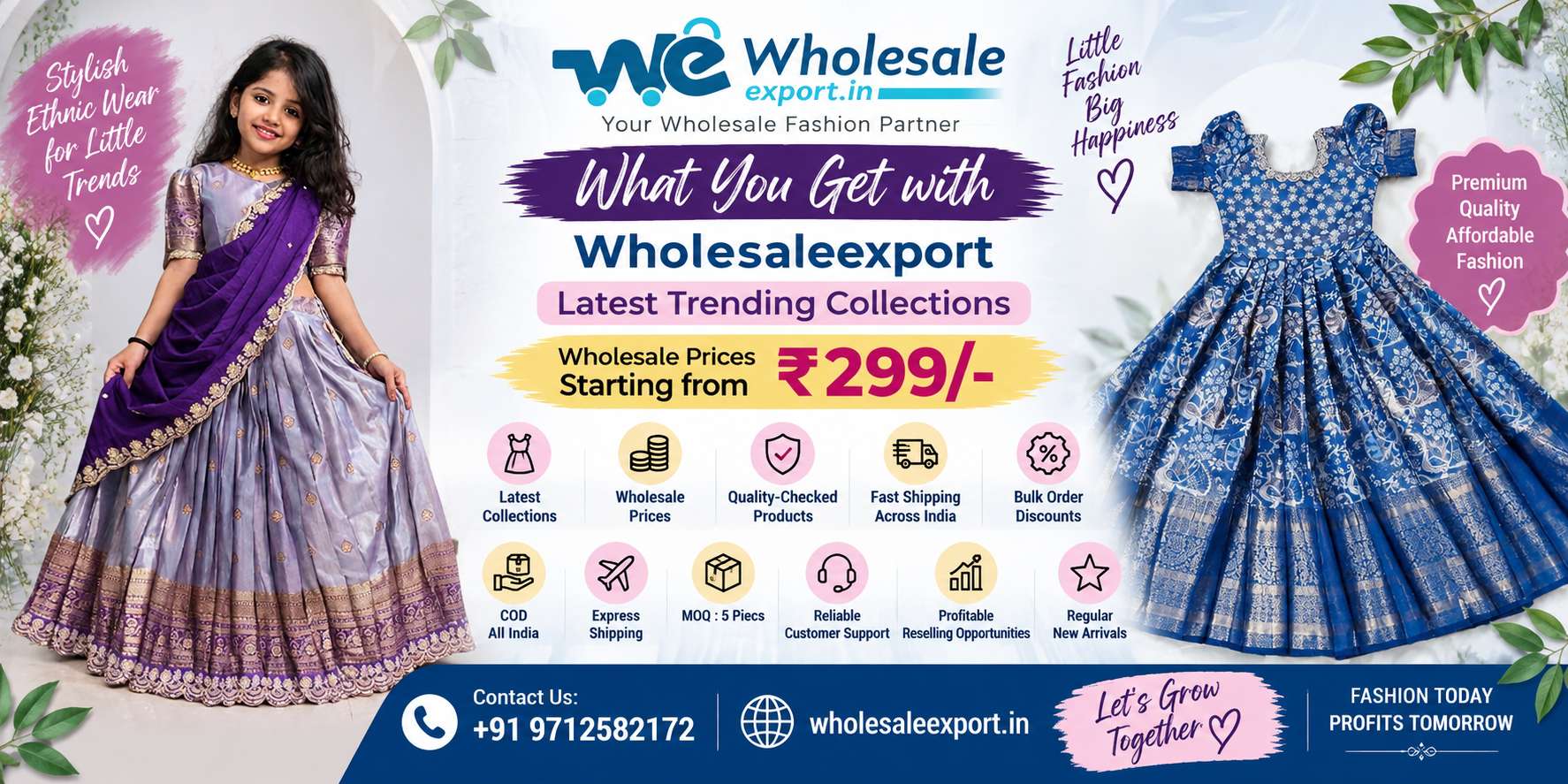
Explore Wholesaleexport.in for Latest Collections, Wholesale Pricing, Trendy Ethnic Wear and sourcing options designed for boutique and wholesale requirements. Buyers can enquire about Fast Shipping, available COD Support, Bulk Order Deals and current product availability.
Quality Products Starting From ₹299 are available across selected collections, subject to current catalog, product and stock availability. For the latest wholesale rates and ordering details, check the current product information before confirming your purchase.
Contact Number: +91 9712582172
Website: wholesaleexport.in
A profitable boutique does not need the largest inventory; it needs inventory that sells. Use this boutique stock selection guide as a framework, study your customers continuously and build every buying cycle around real demand. With disciplined selection, fresh collections and dependable sourcing, boutique owners can improve stock rotation while creating a stronger shopping experience for their customers in 2026.